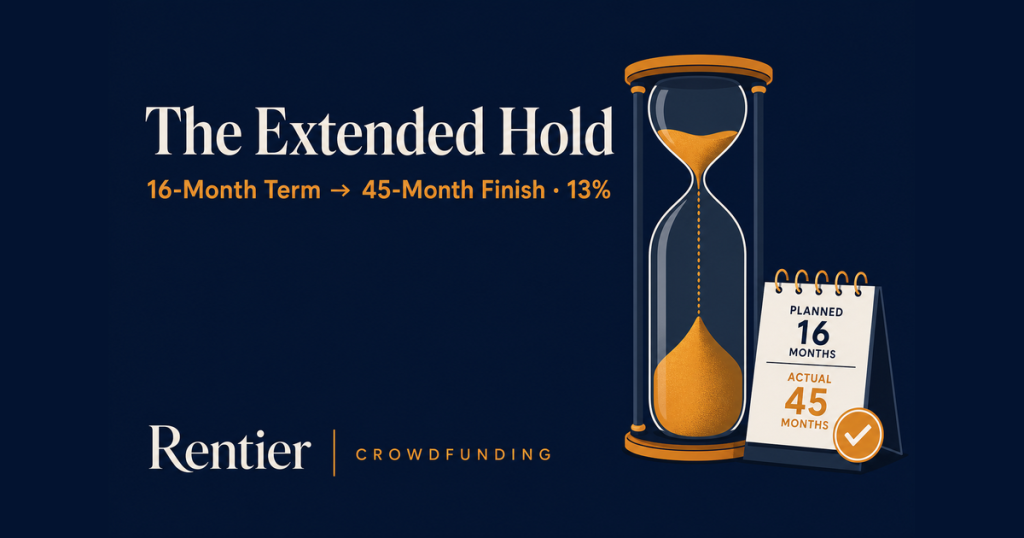
The Extended Hold: A 16-Month Deal That Ran 45
A merchant cash advance portfolio took nearly four years to pay 12.82% — and the thing that saved it was printed on page one all along
My third YieldStreet investment — $70,000 into a portfolio of merchant cash advances — funded in April 2018 on a 16-month term, due back by August 2019. That date came and went with my capital still outstanding. Seven months later, COVID shut down the restaurants, auto shops, and retail stores the money had gone to, and I was still nearly $19,000 short of my principal. This one looked dead, and I wrote it off in my head in 2020. It came back anyway: $87,033 returned over 45 months, a 12.82% IRR against a 13.0% target.
This looks like a rescue story: patience on my part, and a platform that kept negotiating until the money came back. There’s truth in that — YieldStreet went back to the table more than once on my behalf. But the negotiating wasn’t what paid me. What did was a protection that had been sitting on page one the whole time, and that makes this deal the odd one out in my portfolio. On the law-firm loan that cost me $87,723, the marketed protection was a first lien and it was worth nothing. On the pre-settlement pool that paid 13.14%, nothing had gone wrong at all — the money still came back early, because of a change-of-control clause that appeared in no marketing material. Here, for once, the protection on the tear sheet is the protection that worked.
One fact reframes the whole thing. Twenty-seven months after my final payment, the originator filed for bankruptcy; the estate was substantively consolidated with an affiliate and converted to a Chapter 7 liquidation, all of it on the public docket in the Eastern District of New York. So every dollar I got back came out of a company already on its way to failing — worth keeping in mind through everything below.
The order here is the file first and the story second: what the documents said I owned, then how the money arrived, then why 12.82% flatters the result.
The Numbers
| Invested | $70,000 |
| Returned | $87,032.84 |
| Net Profit | $17,032.84 |
| MOIC | 1.24x |
| IRR | 12.82% |
| Estimated term | 16 months |
| Actual term | 45 months |
| Cash movements | 42 in, 1 out |
| Total return, unannualized | 24.3% |
| Average wait per dollar returned | 22.5 months |
Every line of the transaction record:
From the platform’s transaction export for this investment: a single $70,000 outflow on April 17, 2018, and 42 distributions between May 2018 and January 2022. The figures above are recomputed from these cash flows rather than taken on trust — $87,032.84 returned on $70,000, a 12.82% internal rate of return over 1,385 days.
Page One, and the Rest of the File
In April 2018, YieldStreet offered Short Term Small Business Financing I — a $3,040,672 participation in a portfolio of merchant cash advances originated by Quicksilver Capital. My $70,000 funded on April 17.
A merchant cash advance is not a loan. The originator buys a small business’s future credit-card and deposit receipts at a discount, then debits a fixed percentage of daily sales until it has collected an agreed multiple of what it advanced. The memorandum is direct about the product: advances from as little as $2,000, with pre-approval typically within 24 hours.
Page one of the ten-page memorandum:
- 13.0% target investor interest rate against a 15.0% gross rate, with a 2.0% YieldStreet management fee
- Estimated duration 16 months, monthly payments, interest-only followed by an amortization period
- 443 advances, $13.5M gross, average advance $30,568, average factor rate 1.38x over 223 days
- Originator collected 74.1% of advances in full, with a 25.9% default rate and an 8.8% principal loss rate since inception
- A common Reserve Account accumulating “collected interest in excess of YieldStreet’s stated rate to supplement any shortfall”
- “YieldStreet SPV is in a priority payment position” — repaid before the Reserve Account is liquidated
- Cross-collateralization across five portfolios, so “the shortfall of any Advance can be supplemented by the performance of another from the funds accumulated in the Reserve Account”
I checked each of these against the source documents and found no misrepresentation. What follows is what the rest of the file adds.
1. Nothing in the binding documents promised me 16 months
I spent years treating the 16-month estimate as a soft commitment that got broken. It was never a commitment at all, and the documents are unusually clear about this.
The estimate itself was reasonable and consistently stated. Sixteen months from my April 2018 funding lands in August 2019, which is exactly where YieldStreet later put it in writing: the investment “was initially projected to be fully repaid by approximately August 2019.” The body of the memorandum describes the same shape from the portfolio’s side: an 18-month lifecycle made up of a 12-month funding period and an amortization tail of up to 7 months. That sums to 19 rather than 18, a rounding quibble and not a real discrepancy. Every version of the figure was labeled an estimate.
What I missed is what sat underneath it.
| Where duration is addressed | What it says |
|---|---|
| Tear sheet, page one | “Estimated Duration (Months) 16” |
| Subscription agreement §2(d) | I can bear the risk “for an indefinite period of time” |
| Operating agreement §14.01(d) | The same representation, again |
| Operating agreement §2.05 | Vehicle term runs to December 31, 2065 |
| Feb 2020 investor letter | “this investment does not have a slated legal maturity date” |
Sixteen months was a forecast on a marketing page. What I actually represented, in writing, twice, was that I could bear the risk “for an indefinite period of time.” There was no maturity date to breach, no default to declare, and no date on which anyone owed me anything. When the deal ran 45 months instead of 16, nothing had gone wrong contractually. Only my expectations had, and I was the one who’d signed away any right to have them.
That sounds like a complaint. It is closer to the opposite. Having no date is why a 29-month overrun reached me as a slow return instead of a default. A lender that owes fixed sums on fixed dates, against a portfolio that has nearly stopped collecting, is insolvent long before the money arrives — which is how Woodville Consultants ended up in administration holding claims that were probably good. And the reserve described below is why the money arrived at all.
2. A quarter of the advances were expected to default
Page one disclosed a 25.9% default rate. Of every four advances Quicksilver settled, roughly one did not pay in full. The 8.8% net principal loss rate is what remained after recovering 66.8% of principal on the defaulted ones.
In 2018 I read those numbers as reassurance: an 8.8% net loss looked comfortably absorbed by a 15% gross coupon, as if the gap between the two were my margin of safety. The better reading is that a one-in-four default rate is not a warning about this portfolio; it is the business model. Quicksilver prices its advances at a 1.38x factor rate: every dollar advanced is expected to return $1.38 over about 223 days, a spread wide enough that even with a quarter of them defaulting, the pool still clears its 15% gross rate. Nothing was hidden and nothing was understated.
The question I should have asked was not “will defaults stay near 8.8%” but “what happens to me if they double,” and the answer lived in the Reserve Account, not in the loss rate. That reserve, in turn, was funded out of economics thinner than the tear sheet implied: Quicksilver pays independent sales organizations a 7%–8% commission on funded amounts, and the memorandum adds: “the performance figures noted in this memorandum are gross and not inclusive of commission paid.”
3. My collateral was future sales
Two documents describe what actually stood behind my $70,000. The operating agreement calls the asset “participations in merchant cash advances made to retailers through purchases and sales of future receivables”; the memorandum calls the collateral “future credit card and deposit receivables.” Both are describing the same thing from the investor’s side: the receivables themselves, and nothing more. The memorandum’s product description confirms there was nothing else behind them, either — it advertises “no collateral requirements” and “no personal guarantees, liens or hidden fees” as selling points to the merchants receiving the advance, not to me.
The security, then, was revenue that small businesses had not yet earned. Quicksilver collected on it by debiting 13.1% of each merchant’s daily sales straight from the business’s bank account, every business day until the advance was paid off. That mechanism is elegant when a restaurant is busy, and it is not a mechanism at all when the restaurant is closed: 13.1% of zero is zero, and there is no lien to foreclose and no guarantor to pursue.
This is the specific reason COVID hit this deal so much harder than a shutdown would hit a secured lender. A pandemic does not impair collateral of this kind. It deletes it. And the portfolio’s top three business types were auto repair, restaurants, and retail — 41.2% of it, and close to a complete list of what a lockdown closes.
4. The portfolio I diligenced was gone before the risk arrived
For the first 12 months, principal collected from the advances did not come back to me. The originator kept it and redeployed it into new advances for the portfolio’s benefit — including renewals, which Quicksilver issues to about 45% of its advances once the old one has repaid 55% of what it owes, turning a merchant who is still mid-repayment into fresh paper. That is how the structure was designed, and I received interest only during that period.
The consequence is spelled out in the memorandum: “the composition of the Portfolio will change throughout its funding period due to the consistent reinvestment of principal.” The 443 advances I was shown were originated in the first three months of 2018 and had an average term of 223 days, so every one of them had settled or defaulted well before the pandemic. What was outstanding in March 2020 was later paper, selected by the same underwriting rules but never shown to me.
So my diligence had a shelf life of roughly 7 months, and the risk arrived in month 23. I do not think this is a flaw in the structure — revolving is what makes short-duration lending work. It is a flaw in how I read it. I checked a snapshot and believed I had checked the investment.
5. The residual was reserved
The memorandum works through the economics with a clean example, and it is the most useful passage in the document. Take a $5,000 SPV participation in an advance, in one month:
| Where the month’s collections go | Amount | Share of premium |
|---|---|---|
| Collected on the SPV’s behalf | $1,125.00 | — |
| — principal, retained and re-advanced | $833.00 | — |
| — premium collected | $292.00 | 100% |
| To the Reserve Account | $229.50 | 78.6% |
| To YieldStreet, 2.0% management fee | $8.33 | 2.9% |
| To me, 13.0% | $54.17 | 18.6% |
Quicksilver reported a historical IRR of 88.6%. A 1.38x factor rate over 223 days is roughly 69% annualized with reinvestment. The memorandum also works from a more conservative figure, a 1.20x effective factor rate over 214 days calculated after defaults, and even on that basis it says “for each $1.00 advanced, the Originator is collecting on average $1.33 gross (with reinvestment)” — roughly 33% a year on the asset. I was paid 13%.
The operating agreement names the party that collected the difference. Once my 13% preferred return and my capital had been paid, both of the waterfalls that governed repayment — Section 7.01(b) for the amortization period, 7.01(c) for a capital event — end the same way: “Thereafter, to the Class C Member.” The Class C Member is YS QS Reserve A LLC, which holds no voting rights, made no capital contribution, and is the Reserve Account itself.
A capped return with the residual going elsewhere is not unusual by itself. What made this residual different is that it was held in a separate vehicle and pooled across five portfolios, so a shortfall in any one of them could be cured from it. The memorandum states the ranking plainly — “any interest in the Reserve Account is subordinated to the Portfolios’ advances until YieldStreet has realized all its interest and principal” — and it could not be liquidated until every associated portfolio had been repaid in full. So my capped upside was not simply somebody else’s profit. It was a first-loss buffer, built up over the life of the deal, and it is what paid me.
6. Unsecured, blind, and owed no duty
Everything above describes an asset I had no direct claim on. Exhibit A to the subscription agreement says so under the heading “Unsecured Participation Interest,” in wording identical to the other YieldStreet deals in my file:
“The Company holds a participation interest, which is not directly secured against specific assets [. . .] if the Originator becomes insolvent, then the Company’s participation interest could be superceded by the senior creditors of Lenders.”
Quicksilver had lenders of exactly that kind. In March 2018, one month before I funded, it announced a $15M credit facility from a private investment firm. That facility is not mentioned in my memorandum. Nearly three years later, YieldStreet’s January 2021 update told investors it was “in active discussions with the senior lenders regarding the restructuring of the SPV’s position to accelerate recovery.” Whether those were the March 2018 lenders or a later facility, I can’t tell from my file — what matters is that they existed and ranked ahead of me. The tear sheet’s “priority payment position” meant priority over the Reserve Account and nothing more, and by 2021 the platform was negotiating my recovery with parties standing in front of me.
Three more clauses each stripped away a separate protection. These are the ones I check for first now; in 2018 I had not read any of them:
- No fiduciary duty: Section 4.02(m) of the operating agreement eliminates the Manager’s duties to Class A investors like me — “including, but not limited to, the duties of due care and loyalty.” It advises the Company, not me, and says so: it is “not providing any investment advisory services to such Class A Member.”
- Redemption on demand: Section 5.06 lets the Manager redeem my interest “at any time, with or without notice,” for the lesser of my capital account plus accrued distributions or a negotiated figure. On this deal that would have been a kindness — it is the only clause in the file capable of ending a 45-month hold early, and it belonged to them rather than to me.
- No information rights: Section 12.10 restricts me to whatever the Manager chooses to disclose “in its sole and absolute discretion,” which is why I never saw a single merchant, advance, or default across the entire hold.
The subscription agreement then goes further than anything in the other deals, with two clauses that work as belt and suspenders: first, I never relied on the numbers; then, even if I had, the blame for them was Quicksilver’s, not YieldStreet’s.
- No reliance: Section 2(f) has me confirm that I never relied on anything the Company or the Manager told me — “any representations made by, or other information (whether oral or written) furnished by” them — with one exception: whatever is written into the subscription and operating agreements. The memorandum is neither of those. So every number in it that persuaded me to invest falls outside that exception — and by signing, I confirmed I’d relied on none of it.
- No liability: Section 2(g) has me acknowledge that all information about the investment “was provided by the Project Owner and the Company and the Manager shall not be liable or responsible for the accuracy or completeness” of it. So the 25.9% default rate, the 8.8% loss rate, the 74.1% collection rate, and the 88.6% historical IRR were all Quicksilver’s figures, and I had already agreed not to hold YieldStreet responsible for them.
So the position I actually held was this: unsecured behind Quicksilver’s own lenders, with no fiduciary duty running to me, redeemable by the Manager at will, entitled to no information, and standing on figures Quicksilver supplied and YieldStreet had already disclaimed — against the full risk of a portfolio of small-business receivables.
The 45-Month Wait
The 42 payments fall into five distinct phases, and their shape tells the story better than the version I carried in my head.
| Phase | Payments | Cash | Run rate |
|---|---|---|---|
| Interest only, May 2018 – Feb 2019 | 10 | $7,005 | $704/mo |
| Amortization, Mar – Aug 2019 | 6 | $39,804 | $6,621/mo |
| Fade, Sep – Dec 2019 | 4 | $3,914 | $985/mo |
| Trough, Jan 2020 – Mar 2021 | 16 | $4,898 | $328/mo |
| Recovery, Apr 2021 – Jan 2022 | 6 | $31,412 | $3,135/mo |
The first two phases did exactly what the memorandum described. Interest-only payments averaged $748 in the nine full months to February 2019 against a theoretical $758; the difference is the $150 first-year SPV expense. Amortization began in March 2019, one month after the funding period closed, and returned nearly $40,000 in six months. By the August 2019 target I was behind schedule — not alarmingly so, not yet. Then it stopped working.
Two projections, both missed
For years I described this deal as drifting quietly late until COVID finished it off. A letter dated February 18, 2020, three weeks before the first lockdowns, says otherwise. A workout was already running:
“In our efforts to obtain the full target return on the investment, YieldStreet entered into an agreement with the Originator, relating to the Short Term Small Business Financing I, II, III, IV and V Portfolios [. . .] The agreement called for the Originator to provide additional capital into the cross-collateralized Reserve Account, shared across all five portfolios, and to be reinvested accordingly.”
Two things stand out. The remedy was to make Quicksilver top up the Reserve Account — the page-one protection being exercised, not a new arrangement. And the letter set a revised deadline: the portfolio “should fully amortize in advance of April 30, 2021.” Against both dates, here is what had come back:
| Checkpoint | Cash received | % of $70,000 |
|---|---|---|
| Aug 2019 — original estimate | $46,809 | 66.9% |
| Feb 2020 — workout letter | $51,405 | 73.4% |
| Mar 2021 — last payment before Recovery | $55,621 | 79.5% |
| Apr 2021 — revised deadline | $66,312 | 94.7% |
| Jan 2022 — final payment | $87,033 | 124.3% |
The portfolio missed that deadline too. The final payment arrived on January 31, 2022 — 9 months past the revised date and 29 past the original one.
A vote I was bound by, and agreements I never saw
During the trough, two developments deserved more weight than I gave them at the time. In December 2020, YieldStreet asked investors to amend the payment waterfall so that all 2020 distributions were reclassified as principal, ahead of interest. Under Section 13.01, a majority of Class A interests plus YieldStreet’s own consent was enough to bind everyone, and that is what it got. The stated logic was that it was “prudent to reduce principal before recognizing interest income,” and it also avoided a taxable event on income I had no guarantee of ever collecting.
Then, in April 2021, the platform reported that it had “reached agreements to achieve our goal of materially improving the performance of this investment.” YieldStreet has never published what those agreements were, and Section 12.10 is why I was never entitled to find out.
Why 12.82% Flatters This Deal
The gap between the 13.0% target and the 12.82% I realized has nothing to do with credit. Section 5.09 of the operating agreement obliges each Class A investor to pay YieldStreet a flat $150 in the first fiscal year and $70 in every subsequent one, deducted from interest distributions. This position was live in five calendar years, so it paid $150 plus four years of $70, or $430. Add that back and the IRR is 13.15%. The whole shortfall from target is a fixed administrative charge amounting to 2.5% of my profit.
But that gap is trivial. The one that matters is between 12.82% and what actually happened. Every dollar of interest I was owed at 13% on my declining balance arrived, just 29 months behind schedule — a genuinely good outcome, and also why 12.82% reads like success. IRR is a per-year figure, indifferent to how many years there are, so stretching a 13% coupon from 16 months to 45 barely moves it. In unannualized terms I made 24.3% over 45.5 months, and the weighted-average wait to receive a dollar back was 22.5 months — neither figure appears anywhere in my account statements. The rate was never the risk on this deal. The calendar was, and the calendar is the one thing IRR is built not to see.
A Reserve, Not a Lien
My third YieldStreet investment paid its contract rate in full and took nearly three times as long as advertised. It came back because a reserve account funded out of somebody else’s margin, pooled across five portfolios, ranked behind me and could not be touched until I had been paid. A lien is a right to argue in court later. A reserve is money already in the account. I contributed nothing to any of it beyond holding on, and the documents left me no way to do otherwise: no exit, no maturity date, nothing to demand from anyone.
Seven days before this, on the same platform, I put $250,000 into a loan with a first lien, a payment waterfall, and personal guarantees — and lost a third of it. The deal that came with none of those is the one that paid.
Commentary and personal experience — not investment, legal, or tax advice. Investing carries risk, including total loss of capital. Always do your own due diligence.