The Residual Claimant: Two Settlements and the Layer That Doesn’t Shrink
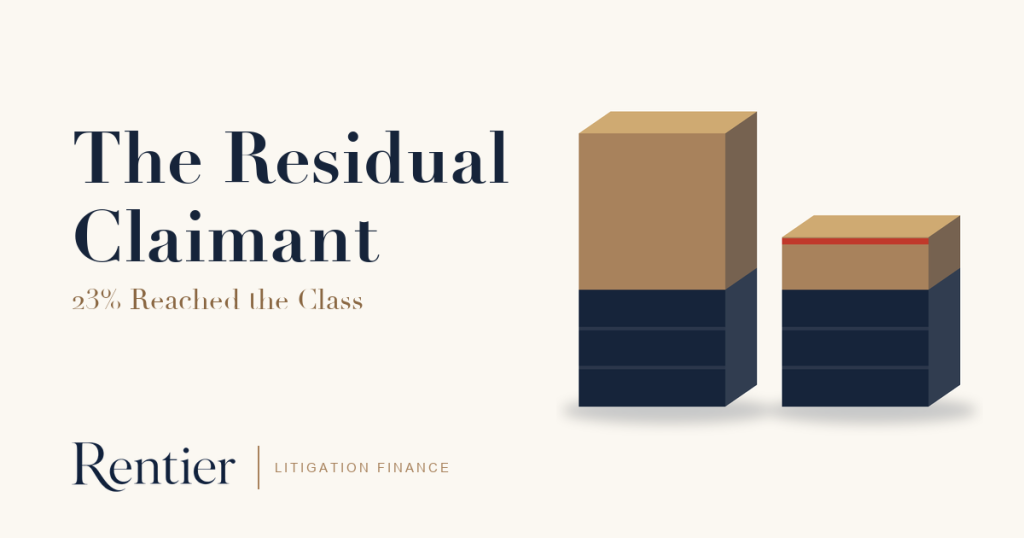
Google will pay £260 million to settle a UK class action and £160 million of that reaches the class. An Australian court approved a A$22.5 million settlement the same week and A$5.12 million reached the group members. The gap between 62% and 23% is not a story about one funder charging more than another. It is that most of what sits above a class is what the case cost to run, and that number does not move when the settlement does.
I am a limited partner in three private litigation-finance funds. When one of them resolves a matter, my share comes out of the same layer that took the £100 million in the Google settlement and the A$8.3 million in the Australian one — the layer that gets paid before the claimants do.
What my quarterly reporting tells me is a case name, a stage and a mark. It has never once told me what fraction of a settlement reached the people whose claim it was. That number is now the test two courts applied this week, and it is the one number my statements omit.
Two settlements, one week
Alphabet agreed to pay £260 million to settle the Competition Appeal Tribunal claim brought on behalf of UK app developers over Play Store commissions. The class representative is Barry Rodger, a competition law professor at Strathclyde, instructed by Geradin Partners; Bench Walk Advisors funded it. The claim was certified in May 2025 and had originally been valued at more than £1 billion. Google admits no liability. An approval hearing is listed for 15 September, and approval would avert a trial due to start on 28 September and run ten weeks.
In the same week, Justice Jonathan Beach approved a A$22.5 million settlement in the Federal Court of Australia, in a claim run by Shine Lawyers and funded by Woodsford against two former Commonwealth Bank wealth management units. The allegation was that advisers failed to act in clients’ best interests over life insurance policies, including by not telling them substantially similar or better cover was available elsewhere.
| Settlement | Total | To the class | To everyone else | Class share |
|---|---|---|---|---|
| Google Play Store (UK) | £260M | £160M | £100M | 62% |
| CommInsure (Australia) | A$22.5M | A$5.12M | A$17.38M | 23% |
In the Australian matter the funder’s share is reported at A$8.3 million. That leaves roughly A$9.08 million for the solicitors’ deferred fees, their uplift and the cost of administering the scheme — a larger number than the funder’s, and a much larger number than the class’s.
Why the residual collapses faster than the settlement
The obvious reading of a 23% class share is that somebody’s percentage was too high, and that reading does not survive the arithmetic. A funder taking a percentage of the outcome absorbs a discount alongside everybody else: if the case settles for a third of what was hoped, a 30% commission pays a third of what was hoped too.
The layer above the class is only partly a percentage. The rest of it is what the case actually cost — counsel’s fees, experts, discovery, the insurance premium, the administration of a distribution scheme to tens of thousands of people. Those are dollars already spent, and they do not know what the settlement came to. A claim that resolves badly does not get a cheaper trial team in retrospect.
So the class is not taking a fixed slice of anything. It is the residual claimant: it gets what is left after a layer that barely moves. When the top of the stack shrinks, the class absorbs nearly all of the shrinkage, because the class is the only part of the structure that is elastic.
The Australian case is the clean demonstration. Lawyerly reported that the claim had been assessed as likely to fail had it gone to trial, which is why it settled where it did. The parties wrote the number down for litigation risk. The costs of having run the case up to that point did not get written down with it, and the residual is what absorbed the difference.
Google runs the same arithmetic from the other end and reaches a much better place. A claim once valued above £1 billion settled at £260 million, and the stakeholder layer still cleared £100 million — but £100 million against £260 million leaves 62% for the class, because £260 million is a large enough number for a sticky cost layer to sit inside without swallowing it. The tribunal will test that split on 15 September. The point is not that Google’s split is bad. It is that the same structure produced 62% in one case and 23% in another, and the difference between them is mostly the size of the settlement rather than the terms of anybody’s agreement.
The Competition Appeal Tribunal has already seen the tail of this. The UK government’s own consultation cites a claim against Stagecoach South Western Trains in which less than £216,000 reached class members while more than £10 million went to lawyers, funders and other advisers. Nothing about that requires anyone to have charged an unusual rate. It requires only a fixed cost layer and a small enough recovery.
The proposal that changes when, not how much
The UK’s Department for Business and Trade published a consultation on the opt-out collective actions regime on 21 July, and it closes on 25 September. Most of the attention has gone to the certification test, which would ask the Tribunal to assess a claim’s “absolute suitability” for collective proceedings and weigh case costs against the benefits likely to reach the class. Underneath that sits a smaller proposal that bears directly on the layer I sit in.
The consultation would introduce a presumption that funders are paid “at the point of a damages award being ordered or a settlement sum approved, without needing to wait for the outcome of distribution,” following the waterfall in the funding agreement, with the Tribunal keeping discretion where that would risk “an unjust outcome.” It would also have the Tribunal indicate the reasonableness of a funder’s return at certification rather than at the end.
That does not change anyone’s percentage. It changes who waits. Distribution in an opt-out case is slow and incomplete — class members have to be found, and many are never found. Under current practice the funder’s return is exposed to how that goes. Under the proposal it is not. Whatever the residual turns out to be, the residual claimant is the one holding it.
I would benefit from this. My funds get paid sooner and with less uncertainty about a distribution process they do not run. I am not going to pretend that is a neutral observation.
What the other side gets right
A 23% class share is not evidence of anything abusive on its own, and the honest counterfactual matters. If the Australian claim really would have failed at trial, the alternative for those group members was not a bigger settlement. It was nothing. A structure that delivers A$5.12 million to people who would otherwise have received zero has done something, and the fact that it cost A$17.38 million to do is a statement about how expensive it is to run a class action against a bank, not proof that somebody was overpaid.
The pricing data cuts the same way. The Australian chapter of Chambers’ Litigation Funding 2026 guide reports that the median court-approved group costs order rate since Victoria’s contingency fee regime began is 24.5%, against a 24% median for third-party funder commissions considered by courts over the seven years to the end of 2023. Two entirely different mechanisms, set by different people under different rules, landed within half a percentage point of each other. That is what a competitively priced layer looks like. The problem this post is describing is not the rate.
And the layer is not a windfall for the people funding it. My own retail experience of the funded side came out at a 1.25% IRR, and part of why it came out there is that the platform gave up some of its own contracted share when settlements arrived light. The stakeholder layer is not immune to a bad outcome. It is simply first in line for whatever there is, and that is a different thing from being protected.
What I actually take from it
The number I want is not the funder’s percentage. Every regime I can see prices that at roughly a quarter, and the two settlements this week are consistent with a market that has settled on a rate. The number I want is the one the Tribunal will look at on 15 September and the one Justice Beach already looked at: what fraction of the gross reached the people whose claim it was.
I have never been given that figure for a single matter in any of my three funds, and I have never asked for it. It is not in the reporting template and I doubt it is a line anybody computes. But it is now the test a UK tribunal applies to whether a settlement is just and reasonable, and if my funds are exposed to matters where the answer is 23%, the risk is not that my return gets clawed back. The risk is that a court declines to approve the settlement my return depends on, or approves it on terms that reopen the waterfall.
That is a question I can put to a general partner in plain language, and it does not require them to tell me anything confidential about a case. I am going to start asking it at the next annual meeting: across the matters this fund has resolved, what share of the gross recovery went to claimants. If the answer is that nobody tracks it, that is an answer too.
Commentary and personal experience — not investment, legal, or tax advice. Investing carries risk, including total loss of capital. Always do your own due diligence.