The VC Myth, Debunked: Why Patent Funders Aren’t VCs
A defence firm says patent funders bankroll junk in the hope one case pays for everything. A funder’s general counsel says the arithmetic makes that impossible. I rebuilt his model and it reconciles to the dollar — so he wins. Then I read what he deliberately left alone, and what his own evidence says about the vertical I used to put money into.
I used to pick patent cases myself, through a retail platform, and the results were bad enough that when I first met the argument that funders are running a lottery, part of me nodded along. It described what I had lived. So I came to this exchange expecting to side with the critics, and left agreeing with the rebuttal on its central claim — while collecting two things it doesn’t resolve.
The Claim and the Answer
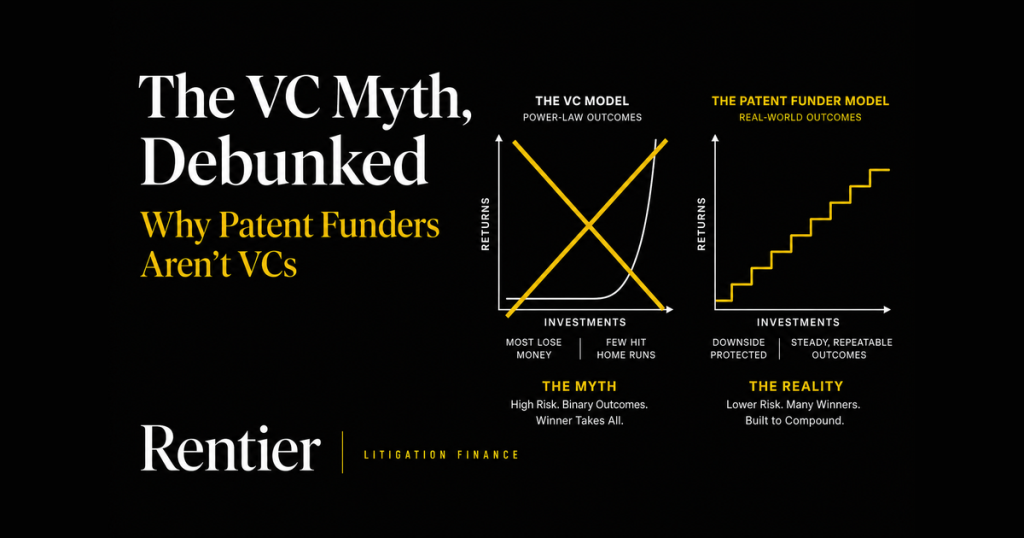
In 2025, four WilmerHale attorneys published The Venture Capital Model Applied to Litigation Funding in volume 26 of The Sedona Conference Journal. The mechanism is stated precisely enough to test: the venture model is one “where 50% to 70% of investments are expected to fail but the few ‘hits’ account for the bulk of the VC profits,” and transplanted into patent litigation it produces funders “motivated to bring a high number of lawsuits—many of questionable merit—based on the chance that a small number may succeed and result in large damages awards.” Lawsuits that are “merely ‘lottery tickets’ in pursuit of a big pay day.” The remedies proposed are funder disclosure plus harder use of fees and sanctions.
In May 2026, Sean K. Thompson answered with Patent Litigation Finance and the Venture Capital Myth, forthcoming in volume 27 of the same journal — forty-one pages arguing the model is unsupported by evidence, impossible as fund arithmetic, and contradicted by the only public return data that exists.
Neither document is disinterested. WilmerHale defends the companies being sued; it won two of the three cases its own article cites. Thompson is Managing Director for IP Investments and General Counsel at Parabellum Capital, a funder, and by his paper’s own footnote he practised previously at Cravath and at WilmerHale. His closing line — that what the authors offer is “advocacy dressed as scholarship” — is not the register of a neutral referee.
I’m not crediting him for neutrality. I’m crediting him because the argument is falsifiable and I checked it. The fund model is arithmetic anyone can reproduce, and the return data is audited public-company disclosure. That’s a different epistemic position from “a lawyer said so,” and it’s the only reason a funder’s brief earns this much of my attention.
The Evidence Behind the Accusation
Start with scale. WilmerHale’s own inputs — an estimate that 30% of patent cases are funder-backed, against roughly 3,800 patent cases filed annually since 2017 — imply about 4,500 funded patent cases since 2022. The support offered for a market-wide strategy is one enforcement campaign and two cases in a footnote.
Their primary example is Fortress-backed VLSI against Intel. On the payoff mechanism the theory needs, it fails: the $2.18B verdict didn’t survive appeal and no money has been collected. It’s also structurally the wrong exemplar for third-party funding, because Fortress created VLSI, bought the patents from NXP, and staffs a majority of the board with its own employees — principal investing in an assertion vehicle, not financing an independent claimant’s claim. The two footnoted cases are weaker still. In AVM v. Intel a jury found non-infringement, and Intel never sought fees on the ground the case was baseless. In Akamai v. MediaPointe, Akamai did seek fees for baselessness and the court denied the motion without oral argument, finding “nothing about this case, singularly or cumulatively, brings it outside of the mine-run of patent litigation cases.”
The sharpest catch is one I’d missed before reading the paper closely: WilmerHale repeatedly leans on IP Edge, and IP Edge isn’t a litigation funder at all. It’s a high-volume patent assertion entity that buys patents and asserts them through LLCs — roughly 70% of its cases terminate within 180 days of filing, and its reported settlements run an order of magnitude below the cost of an inter partes review. Whatever that says about the patent system, it says nothing about litigation finance, because those economics could not sustain a fund.
Thompson is careful here in a way that’s worth noting, because it’s the opposite of how advocacy usually works: he concedes that the absence of sanctions doesn’t prove a case was strong, and says the evidence that would actually support the thesis is comparative — case quality, attrition and outcomes across funded versus non-funded matters. Nobody has produced that.
The Arithmetic, Rebuilt
The heart of the paper is a fund running exactly the described strategy. Ten single-case patent investments, $10M committed each, six losers, three modest winners, one case carrying the fund. I rebuilt every line, including the waterfall algebra, and it reconciles.
The six failures are assumed to die at different points in the litigation, deploying an average of 45.8% of committed capital — an assumption generous to the accusers, since real campaigns cost more. Thompson notes VLSI reportedly paid $35 million for the NXP patents alone, before a dollar of legal fees, which by itself exceeds the whole per-case commitment in the model.
| Case outcome | Deployed | Recovered | Net |
|---|---|---|---|
| Cases 1–6: pleading dismissal, IPR cancellation, adverse claim construction, two summary judgments, defence verdict | $27.5M | $2.5M | −$25.0M |
| Cases 7–9: settlements | $26.0M | $35.7M | +$9.7M |
| Position entering the carry case | $53.5M | $38.2M | −$15.3M |
Three winning settlements don’t dig the fund out. It enters Case 10 $15.3M underwater, with total deployment reaching $63.5M. Now apply the waterfall the GAO uses and the WilmerHale article itself cites approvingly — 2x deployed capital off the top, then 20% of the remainder — and solve for what the carry case must generate in collectible gross proceeds.
| Portfolio gross target | Needed from Case 10 | Gross case proceeds required | Implied Case 10 MOIC |
|---|---|---|---|
| 2.0x | $88.8M | $364.0M | 8.9x |
| 2.5x | $120.6M | $523.0M | 12.1x |
| 3.0x | $152.3M | $681.5M | 15.2x |
| 3.5x | $184.1M | $840.5M | 18.4x |
Commercial litigation finance funds generally target roughly 2x net MOIC and about 20% net IRR. A 2.5x gross target is approximately that, and it demands one case producing about $523 million of collectible proceeds. Push to a VC-like 3.5x gross and the requirement approaches $1 billion.
That’s the multiple-only view, and multiples are the flattering half. Fund performance is judged on IRR, and these cases run a decade. The same 2x looks entirely different depending on when it arrives: 2x in two years is roughly a 41% IRR, while 2x in ten years is about 7.2%. Modelling discrete cash flows over a ten-year path, the carry case needs to deliver about $216M to the fund for a 20% portfolio IRR — roughly $1 billion in gross proceeds — and about $333M for 25%, or roughly $1.6 billion.
So the accusation reduces to an empirical question: does patent litigation reliably produce collected half-billion-dollar recoveries?
The Ceiling
It doesn’t, and the reasons are structural rather than incidental.
Damages are bounded by statute and doctrine. Section 284 allows damages “adequate to compensate,” and where a patent covers a component of a multi-component product, apportionment confines the patentee to the value of the patented feature. More fundamentally, the asset is different in kind from venture equity: a claim against Google for infringing certain patents is a claim to a sum of money, not a share of Google that compounds with the company. Sutter Hill turned under $200M into a stake worth about $12.6B at Snowflake’s 2020 IPO — over 60x. There is no patent-litigation equivalent, and a strategy that needs one will not find it.
Then the appellate court takes a share of what’s left. Bowman Heiden’s study of Federal Circuit damages decisions from 2010 to 2025 covers 82 cases in which awards above $10M were appealed to final decision. Only 38% were upheld. Above $100M the survival rate is 30%, dropping to 10% once biotech cases are excluded — and biotech is not commonly funded. Above $500M the survival rate is zero. Heiden’s conclusion is that very large awards, “while headline-grabbing, are illusory.”
Thompson lists that study’s weaknesses himself, which is the behaviour that made me willing to rely on the rest of the paper. The sample only captures cases both appealed and decided on the merits, so there are selection effects; some post-verdict settlements preempt appeal precisely where the defendant’s position is weak, which would exclude awards that might have survived, though those settlement terms already price in expected compression; and the sample at the top end is small. His argument is that the direction of the bias is ambiguous and the magnitude unlikely to be large enough to matter, because the probability of a very large verdict surviving and converting to cash is far too low to anchor a strategy either way. I think that’s right, and it’s the honest way to use the number.
Uniloc v. Microsoft — cited by WilmerHale itself — is the pattern in one case. A $388M jury verdict, JMOL for Microsoft on non-infringement, the Federal Circuit reversing that JMOL but affirming a new damages trial because the award was “fundamentally tainted by the use of a legally inadequate methodology,” and eventually a confidential settlement presumably far below the headline.
Two further compressions matter to an investor and get less attention. The first is time. VirnetX is one of the most successful patent assertions in modern history and Apple did pay it $454 million — about a decade after filing, with the broader dispute running roughly fourteen years, ending in 2024 when the Supreme Court declined to review the Federal Circuit’s reversal of a separate verdict above $500M. The second is who sits across the table. Over the past decade Apple has been party to roughly 425 patent litigations, Samsung Electronics America 521, Google 391. These defendants know as well as anyone that mega-verdicts don’t survive appeal, and they settle accordingly.
The insurance market learned the same lesson with its own money. VLSI’s $2.2B verdict was reportedly insured for about $300M — itself a price on appellate-adjusted value. After the Fifth Circuit reversed a $1.6B judgment insured by carriers including Liberty Mutual for a reported $500–750M, Liberty withdrew from other pending judgment-preservation deals and paused quoting new active-litigation liability, and the market moved to smaller placements. I’ve since watched the limits of that product in a live deal, where a $60M policy written on a $213M verdict couldn’t fire because the appeal produced a remand rather than a final judgment.
What the Distributions Show
The arithmetic says the strategy can’t work. The disclosed data says nobody large is running it.
Venture returns really are tail-driven. Correlation Ventures examined 21,640 financings from 2004 to 2013 and found roughly two-thirds failed to return capital, with only about 4% producing 10x or more; a later update found about half of all capital invested in exiting venture-backed companies lost money. Horsley Bridge data shows roughly 6% of investments, representing 4.5% of dollars, generating about 60% of total returns.
Now the same test on litigation finance. Omni Bridgeway discloses all 813 completed investments segmented into six return bands, against A$974M deployed:
| Cohort | MOIC | Share of capital |
|---|---|---|
| A — losses (241 investments) | 0.2x | 22% |
| B | 1.5x | 30% |
| C | 2.4x | 22% |
| D | 3.4x | 13% |
| E | 5–10x | 7% |
| F — 10x and above (144 investments) | 10.0x | 6% |
Three readings, in ascending order of how much they matter.
The loss rate isn’t close. Cohort A is 22% of deployed capital, and because losing matters produced partial recoveries, the share of dollars actually not recovered is 17%. Burford’s losses run about 15% of deployed capital, with adjudicated losses alone around 8%. By investment count the figures are roughly 30% for Omni and 32% for Burford. The accusation requires 50–70%. Even the highest of these is less than half the lower bound.
The middle carries the book. Omni’s cohorts B through D — 1.5x, 2.4x and 3.4x — are 65% of deployed capital and about 56% of realised gains. Burford’s two moderate bands, spanning 1.0x to 2.99x, are 72% of capital and 46% of gains. The value sits in hundreds of ordinary outcomes.
The tail isn’t load-bearing. Cohort F is 6% of capital at 10x or better, producing about 25% of realised proceeds — or about 39% of realised gains, and it’s worth giving both figures because the venture “60%” isn’t explicit about which basis it uses. Either way it’s well short of 60%. The decisive test is removal: strip Cohort F out entirely and the remaining 94% of capital still returns about 1.9x. Venture without its tail is a bad business. This is a business without a tail.
Outcome types tell the same story. Of Omni’s completed investments, settlements were 431 matters and 57% of capital, returning 2.6x over a 3.3-year weighted duration and producing roughly two-thirds of total profits; adjudicated wins were 204 matters at 3.4x over 3.8 years; adjudicated losses were 178 matters at 0.15x, meaning even the failures returned something. Burford’s shape matches — settlements are 78% of deployments at about 1.7x and about two-thirds of cumulative profits.
And the behaviour that produces this is rejection, not selection of variance. Omni has historically passed 2–5% of applications, and in its most recent fiscal year funded 40 of 1,730 — a 2.3% conversion rate. The GAO, interviewing eight major patent funders for its December 2024 report, found almost all “typically fund 5 percent or fewer of the patent litigation cases that they consider.” Because non-recourse capital carries total-loss risk, the work goes in before deployment.
What the Paper Deliberately Doesn’t Do
Here’s where a reader looking for investment conclusions should slow down, because the paper’s scope is narrower than its reception suggests — and Thompson says so plainly. He is answering the descriptive economic claim, “not their specific policy proposals.” His conclusion concedes that “reasonable people can and do disagree about disclosure obligations, fee-shifting calibration, and foreign-funding restrictions,” and that those are “policy questions worth debating on the merits.”
That matters because the strongest material in the WilmerHale article isn’t the lottery thesis at all. Read what it actually says about VLSI. The argument is about cost imposition — eight cases, 23 patents, five jurisdictions, eight years, with Intel diverting tens of millions to defend — and about concealment. Two specifics carry real weight. Intel could only assert a licence defence after discovering that Fortress controlled both VLSI and Finjan, a company Intel already had a licence with; a jury found that control in May 2025, though VLSI disputes the characterisation, arguing its board members serve in a fiduciary capacity for the funds that own the entity. And in a 2022 Delaware case, ordered to identify its investors, VLSI dismissed a claim seeking $4 billion rather than comply. The article adds that Fortress is owned by Mubadala Capital, an Abu Dhabi sovereign wealth fund, and that Purplevine IP, a Chinese firm, funded patent suits against Samsung and received confidential Samsung information.
None of that depends on the VC model being real. A licence defence that only surfaced when a funder’s control did is a disclosure problem whether the funder runs a lottery book or the most disciplined shop in the market. Thompson’s response is about representativeness — VLSI isn’t conventional third-party funding — and he’s right about that, but representativeness is an answer to “is this typical,” not to “did non-disclosure hide a defence worth billions.”
So the honest summary is narrow and useful: the lottery accusation is refuted, and the disclosure case is untouched, because nobody in this exchange contested it. An investor who reads “the VC myth is debunked” as “the reforms rest on nothing” has drawn a conclusion the paper explicitly declines to support. Disclosure is also the reform actually arriving — through the states, the ITC, and the federal rules — and it’s worth knowing which federal vehicle bites. The Senate bill everyone quotes applies only to a “covered civil action,” defined as an MDL proceeding, a class action, or a consolidated proceeding of 100 or more actions; a single funded patent case is none of those. Following that scope limit through the wider reform wave points at the proposal to amend Rule 26, which has no scope limit and would reach one commercial claim on the same terms as a 4,000-plaintiff mass tort.
Who Controls Settlement
The model also requires funders to override claimants and chase outliers. Thompson’s answer is that in conventional funding the claimant keeps settlement authority: a funder can refuse to fund further, but it cannot make a patent owner reject $50M to gamble on $500M, and a high-eight-figure resolution is life-changing for an individual inventor and highly attractive to a university or a small company. He also disposes of the counter-example critics reach for. In the Burford–Sysco dispute, the original agreement contained no settlement consent right at all; Sysco breached by assigning claims without authorisation, the consent right was granted to settle Burford’s breach claims, and the endgame was assignment of the claims to a Burford affiliate. Funder control there was a remedy for counterparty breach, not a standard feature.
My own reporting complicates the strong version anyway. The credit agreement in the “Take Care of Maya” financing gave claimants nominal “sole, final, and unconditional” control while barring settlements that “adversely affect the interests of the lenders,” requiring notice of offers, and making a change of counsel without consent an event of default. Funders do sometimes buy substantial settlement influence. The reconciliation is product type — that was post-judgment monetisation of an existing verdict, not pre-verdict case funding. Thompson’s point holds for the product he describes. It isn’t a general law about everything a funder signs.
The Vertical Question
Now the part that changed what I’d ask a manager. Thompson’s paper contains a footnote arguing that a diversified fund is no defence for a bad vertical: managers “typically evaluate each investment vertical as its own profit center,” and a patent book running high losses “would not be rescued by strong performance in, say, commercial litigation or antitrust.” I agree, and it licenses the obvious follow-up question, which is what the patent vertical actually returns when it isn’t failing.
Burford discloses enough to look. Across 46 concluded and partially concluded IP investments, roughly $332M deployed has returned about $607M — an aggregate 1.83x, with about 35% of investments by count at or below breakeven. Convert that to an annual rate over the five-to-seven-year patent trial-and-appeal cycle and you get high single digits to low teens, gross, before fund fees and carry. Against a target of about 2x net and 20% net, and against Omni’s commercial book settling at 2.6x over 3.3 years, that is a thin result for binary legal risk.
But I have to be careful here, more careful than I was when I first worked through this, because the same disclosure contains three things that cut the other way.
- The book is young and the completed slice is loss-weighted. About 70% of Burford’s 90 IP investments aren’t fully concluded. Losers close in a single event — a dismissal, an IPR cancellation — while multi-defendant winners pay in stages and stay open. The 26 fully concluded investments show 1.37x; the concluded portions of the 20 partially realised ones show about 2.86x, with only one below water. Judging the vertical on what has closed is judging it on its failures.
- One deal drags the winners. Among the 13 fully concluded IP investments with positive returns, the capital-weighted multiple is about 1.85x — but that includes a single large 2024 pharmaceutical investment that deployed $99.9M and returned $125.0M, a 1.25x. Exclude it and the other twelve winners deployed $65.2M and returned $180.0M, about 2.76x. “IP” is not “patent,” and one big low-multiple pharma deal is doing a lot of the work in the headline figure.
- At least one patent-focused funder had the opposite experience. Validity Finance lost its anchor investor and cut half its staff — and reported winning all eight of its completed patent investments, then narrowing its strategy to patent cases exclusively on the strength of that record. Whatever killed Validity, it wasn’t patent loss rates.
So I’d state it more carefully than I would have before reading the asset-level data: the patent vertical’s disclosed returns are moderate, its ceiling is genuinely capped by the Federal Circuit, and the public evidence is too young and too mixed to call it a bad business. What survives is the shape rather than the verdict — bounded upside, long duration, and no tail to bail out a mistake. Notably, the funders themselves appear to have priced that shape: the migration I’ve written about separately, away from single marquee cases toward patent families run as licensing campaigns, is what you’d build if you knew your upside was capped and your median win was well under $100M.
Where the Accusation Is True
The VC model isn’t a description of nothing, and I’m the evidence. There is a tier of this market — retail platforms, deal-velocity originators, the briefly hot mega-verdict insurance trade — where something close to spray-and-pray genuinely happened. My own 42 cases through a retail platform returned about 1.25% a year, and this paper is a structural explanation for that. The platform didn’t fail because litigation finance doesn’t work. It failed because the discipline that makes it work — declining 95% of what you see, underwriting collectability rather than liability, building for the 1.5x–3.4x band instead of chasing tails — is the opposite of what a deal-velocity business can do.
WilmerHale’s error isn’t inventing the pattern. It’s projecting the market’s worst tier onto the disciplined funders defined by avoiding it. And the pro-funder data earns its own asterisk, which Thompson grants: two public companies are not the market, most funders disclose nothing, and the patent-specific sample is small. His answer is that the structural argument doesn’t depend on who attempts the strategy, because it fails on arithmetic regardless. That’s correct, and it’s also the reason the data limitation doesn’t rescue the accusation.
Where I Land
- The lottery accusation is false, and you don’t have to trust a funder to see it. The model reconciles to the dollar: a 50–70% loss rate needs collected half-billion-dollar recoveries, rising toward a billion once you price a decade of duration, and the Federal Circuit has never let awards of that size through. The disclosed distributions confirm it from the other end — 17% of dollars actually lost, and a 10x+ tail contributing a quarter of proceeds rather than the three-fifths venture lives on.
- Winning that argument does not answer the disclosure case, and the paper doesn’t claim to. The strongest thing in the article it rebuts is a documented concealment problem: a licence defence that surfaced only when a funder’s control did, and a $4 billion claim abandoned rather than name its investors. That stands whatever the portfolio economics look like, and it’s the half of reform actually arriving.
- Patent is the bounded vertical, not necessarily the bad one. Disclosed IP returns sit around 1.83x on a young, loss-weighted book whose headline is dragged by one pharmaceutical deal, with the partially realised winners nearer 2.86x. The reliable conclusion isn’t a return number, it’s a shape: capped upside, decade timelines, and no outlier to cover an error.
So my money keeps going to managers who reject the overwhelming majority of what they see, rather than to cases I pick myself. What I’ve added is a question I didn’t have before, and it’s a vertical-level one: what share of this book is patent, what is that share underwritten to return, and over how long. Thompson set out to debunk a policy myth and did. Along the way he supplied the arithmetic that explains why the part of this asset class I originally bought into was never going to pay me what I thought it would.
Sources
- Sean K. Thompson, Patent Litigation Finance and the Venture Capital Myth, 27 Sedona Conf. J. ___ (forthcoming 2026); publication page. Preprint dated May 14, 2026, licensed CC BY-NC 4.0. Cited above for: the hypothetical portfolio and the 45.8% average deployment on failed cases (Tables 1–2); the required gross proceeds at each portfolio target (Table 3) and the duration-adjusted $1bn/$1.6bn figures at 20% and 25% IRR (n.43); litigation finance funds targeting ~2x net MOIC and ~20% net IRR against VC’s ~3.5x and 20–24%; the 2x-in-two-years versus 2x-in-ten-years IRR illustration (n.36); the treatment of Heiden’s methodological limitations; the IP Edge point (n.21); the Burford–Sysco control analysis (n.78); the vertical-as-profit-centre argument (n.44); the Validity, Woodsford and Therium contractions (n.116); the author’s prior practice at Cravath and WilmerHale (n.1); and the scope statement declining to address the policy proposals
- Michael J. Summersgill, Todd Zubler, Makenzi Herbst & Nicolette Willis, The Venture Capital Model Applied to Litigation Funding: Misaligned Incentives and the Harm to Innovation, 26 Sedona Conf. J. 797 (2025) — the 50–70% failure framing and “lottery tickets” language; the 30%-of-patent-cases estimate; the VLSI campaign (eight cases, 23 patents, five jurisdictions, 22 patents dropped or invalidated); the Fortress/Finjan licence defence and the May 2025 jury finding on control; VLSI’s dismissal of a $4bn claim rather than identify investors; Fortress’s ownership by Mubadala Capital; the Purplevine IP/Samsung example; and the AVM and Akamai v. MediaPointe footnote
- Bowman Heiden, The Survival of U.S. Patent Damages on Appeal: An Empirical Study of Award Size and Affirmance Rates (Sept. 21, 2025) — 82 Federal Circuit damages decisions on awards above $10M, 2010–2025: 38% upheld overall, 30% above $100M falling to 10% excluding biotech, 0% above $500M; upheld awards averaging $103M against $267M for non-upheld, with a median nearer $35–40M; “very large damages awards, while headline-grabbing, are illusory”
- U.S. GAO, GAO-25-107214, Intellectual Property: Information on Third-Party Funding of Patent Litigation (Dec. 2024) — interviews with eight major patent funders; almost all fund 5% or fewer of the cases they consider; the illustrative 2x-then-20% waterfall
- Burford Capital, Q4 and FY 2025 results and Principal Finance asset data as of 31 Dec. 2025 — 277 concluded and partially concluded assets; ~15% loss rate by capital and ~8% on adjudicated matters; the moderate ROIC bands at 72% of capital and 46% of gains; settlements at 78% of deployments and ~1.7x; and the asset-level IP figures (46 assets at ~1.83x; 26 fully concluded at 1.37x; 20 partially concluded at ~2.86x; the 2024 pharmaceutical investment at 1.25x on $99.9M; twelve remaining winners at ~2.76x; a single asset above 5x and none above 10x). The asset file also reports IRR and weighted average life per investment, so an IP-specific duration is computable from it; the five-to-seven-year cycle used above is the practitioner range applied by me, not a figure taken from the file
- Omni Bridgeway, Introduction to Omni Bridgeway and analyst data pack (Mar. 25, 2026) — 813 completed investments and A$974M deployed; the six-cohort table; the 22% capital-weighted loss rate and 17% effective loss rate; Cohort F at 144 investments, 6% of capital, ~25% of proceeds and ~39% of gains; outcome-type multiples and durations; and the 2–5% historical screening rate with 40 of 1,730 funded in the most recent fiscal year
- Chris Dixon, Performance Data and the “Babe Ruth” Effect in Venture Capital, a16z (2015) — Horsley Bridge data, ~6% of investments and 4.5% of dollars producing ~60% of returns; Correlation Ventures’ 21,640 financings via Seth Levine; Ari Levy on Sutter Hill’s Snowflake stake, CNBC (Sept. 16, 2020)
- Adrian Ivashkiv, Intermediation Effects in Litigation Finance, 58 Conn. L. Rev. 23 (2025) — finite litigation returns implying constant-multiple underwriting rather than power-law bets, and funded-matter success rates reported between 75% and 90%
- Uniloc USA, Inc. v. Microsoft Corp., 632 F.3d 1292 (Fed. Cir. 2011); 35 U.S.C. § 284; LaserDynamics, Inc. v. Quanta Computer, Inc., 694 F.3d 51 (Fed. Cir. 2012) (apportionment)
- Litigation Funding Transparency Act of 2026, S. 3826, 119th Cong. — the “covered civil action” scope limit; IPWatchdog on the Lawyers for Civil Justice / Institute for Legal Reform proposal to amend FRCP 26(a)(1)(A) (Mar. 12, 2026)
Both journal articles cited above are publicly available, and Thompson’s preprint is published under a Creative Commons licence. Neither author is disinterested; this post relies on the parts of each that are independently checkable and says where it doesn’t.
Commentary and personal experience — not investment, legal, or tax advice. Investing carries risk, including total loss of capital. Always do your own due diligence.