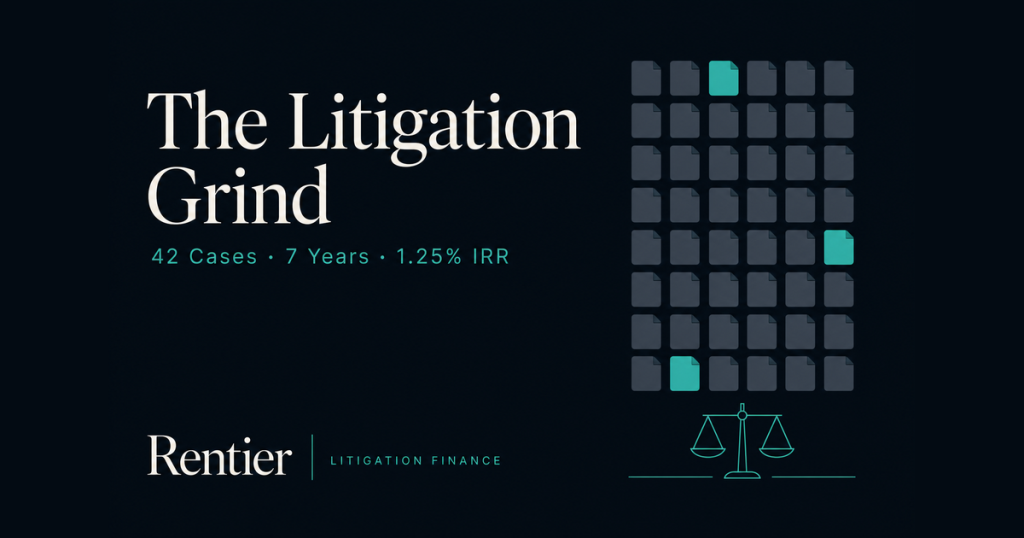
The Litigation Grind: 42 Cases, 7 Years, 1.25% IRR
An eight-member investor group put $2.3M into 42 commercial lawsuits on a retail platform and came out roughly where it started. The win rate was survivable; what the wins paid was not. The platform priced just under the funders who had already turned these cases down, underwrote them at generous values, and then gave up part of its own share when the settlements came in light.
The Bottom Line
Between 2017 and 2020, my investor group put $2.3M into 42 commercial litigation cases on LexShares.
We barely broke even.
| Total Invested | $2,331,000 |
| Members | 8 |
| Cases | 42 |
| Record | 20 wins, 15 losses, 7 pending |
| Resolved IRR | 1.25% |
| Resolved MOIC | 1.05x |
On resolved cases the group got back $1.05 for every dollar invested — barely positive, after more than seven years of holding assets nobody could sell. The last resolution, Passport Patent in January 2026 at 1.84x, is what pushed several members from underwater to breakeven. A nine-year-old patent case arriving at the end was the difference between a bad outcome and a slightly worse one.
My Portfolio
I invested $1M of the group’s $2.3M — about 43% of the total, and the core of my all-in bet on litigation finance. My 4.98% beat the group’s 1.25%, and I want to be careful about claiming credit for that. We all stopped investing after Q1 2020, so it isn’t that I timed the exit better. What separated us was position sizing, not selection: some members concentrated heavily in cases that went badly, and I happened not to. Spreading $1M across 17 cases is a decision I can defend. Which 17 I ended up holding is mostly luck.
| My Portfolio | Group Total | |
|---|---|---|
| Invested | $1,000,000 | $2,331,000 |
| Cases | 17 | 42 |
| Record | 9W-4L-4P | 20W-15L-7P |
| Resolved IRR | 4.98% | 1.25% |
Wins (9 cases, $420K invested → $699K returned)
| Case | Invested | Returned | MOIC |
|---|---|---|---|
| Toy Licensing | $25,000 | $64,135 | 2.57x |
| Passport Patent | $25,000 | $45,897 | 1.84x |
| NFL Fraud | $75,000 | $134,295 | 1.79x |
| Trade Secrets | $150,000 | $263,269 | 1.76x |
| Roundup | $25,000 | $42,399 | 1.70x |
| Medical Finance Fraud | $30,000 | $50,703 | 1.69x |
| Fuel Injection Patent | $30,000 | $33,710 | 1.12x |
| Trademark | $50,000 | $54,970 | 1.10x |
| Software Contract | $10,000 | $10,000 | 1.00x |
Losses (4 cases, $350K invested → $150K returned)
| Case | Invested | Returned | What Happened |
|---|---|---|---|
| Transit Lease | $82,500 | $0 | Rejected $5M settlement, lost at trial |
| Commercial Lease | $50,000 | $0 | Lost at trial, lawyer withdrew, appeal dismissed |
| Counterfeit Equipment | $47,500 | $0 | Spoliation sanctions |
| Knights of Columbus | $170,000 | $149,937 | Won trial, but $500K verdict vs $100M claim |
Performance by Vintage
| Year | Record (W-L-P) | IRR | Notes |
|---|---|---|---|
| 2017 | 5-4-2 | -2.81% | Early deals, mixed results |
| 2018 | 6-3-3 | 4.68% | Best vintage |
| 2019 | 6-8-2 | 0.75% | More losses than wins, but late resolutions helped |
| 2020 | 3-0-0 | 17.48% | Small sample, all resolved positive |
The vintage column argues against one story and confirms a worse one. It’s not that a single bad year dragged the average down: 2017 posted -2.81% on the better win/loss ratio (5-4, or 56%), while 2019 finished barely positive on a worse one (6-8, or 43%), rescued by late-resolving cases like Passport Patent at 1.84x. That gap tracks which cases happened to resolve in time, not which vintage was underwritten better. The good years are the ones where something paid out quickly; the bad ones are where cases just sat.
The worse story is in the 2020 row, the cleanest test in the table: three investments, all winners, nothing left outstanding. A cohort like that isn’t supposed to just meet the fund’s blended 25%+ target; it’s supposed to clear something like 40%+, because the winning years are what cover the years when losses land. It posted 17.48%. Three cases is too small a sample to prove anything on its own, but no other vintage points the other way. Even with no losses to make up for, the best year in the book couldn’t clear the bar a winning year has to clear to carry a losing one.
The Size of the Gap
LexShares was a crowdfunding platform that sold stakes in individual litigation cases, and later launched pooled funds alongside it (Marketplace Fund I and II). Our group bought individual cases rather than fund units, which turned out not to matter much — the same underwriting produced both.
The scale of the shortfall only becomes clear next to a sophisticated funder running the same strategy in the same segment — single commercial cases at mid-market size, not the law-firm portfolios and specialty structures the largest funders, like Burford or Parabellum, use to put institutional-scale capital to work:
| Metric | LexShares (Our Group) | Mid-Market Peer |
|---|---|---|
| Win rate | 57% (20W / 35 resolved) | 70%–80% |
| Net MOIC (resolved) | 1.05x | 2.0x target |
| Net IRR (resolved) | 1.25% | 25%+ target |
| Avg. duration (resolved) | 41 months | Underwritten to 18–24 months |
| Cases funded / reviewed | ~3% claimed | ~3% |
| Carry | 25%, per deal | 20%, fund level, 8% pref |
One line in that table matches, and it is the one LexShares advertised. Its own Fund II deck shows roughly 3,400 cases reviewed across 2016–2019 against 103 deals funded since inception — right around 3%, the same headline selectivity the peer reports. I don’t believe the number. LexShares’ top of funnel was an algorithmic docket scrape that had indexed 825,000 complaints and surfaced more than a thousand a day, so a case counted as reviewed may have had nothing but a glance from the software that flagged it. Declining 97% of a machine-generated list is not the act of judgment that declining 97% of a hand-built pipeline is, and a ratio like that measures the scraper rather than the underwriting.
Every other line is a miss. The first two are related: the win rate sets how many cases have to carry the book, and the average multiple on those wins decides whether they can. On the win rate, there is no need to hold LexShares to anyone else’s standard, because its own co-founder set one. Greenberg said on a conference panel that a funder should be targeting 80% or better, and that anyone who couldn’t clear that had no business in this asset class. His own platform never showed it. The reported win rate slid from 91% in 2017 to 70% by the Fund II raise in 2020, and even that 70% missed his bar. That figure covered the whole platform; ours is 57% today, across the 35 of our 42 cases that have resolved. A 57% win rate is survivable in isolation. It’s fatal in combination with the multiples LexShares actually delivered. At 57%, the winners have to average about 1.75x just to give the money back — before any profit, and before anything for the years of waiting. They didn’t get there.
None of which means the platform’s documents were wrong on their face. They mostly said the right things: that it was picky, and that it wanted claims worth many times what it put in. The gap was never between what LexShares wrote down and what a sophisticated funder writes down. It was between the standard on paper and the one applied in practice. Three things broke, in that order: the underwriting that picked and priced the cases, the fund structure built on top of it, and the reporting that kept both out of view.
The Underwriting
Three risks decide whether a case pays: liability (will the plaintiff win?), damages (how much?), and collectability (can the defendant actually pay?). LexShares had a stated test for each one. None of the three is about time, and time is what this book turned out to have the most of. What follows is who set those tests, which cases got through, what the money cost, what the wins paid, how long they took, and whether the paperwork could collect.
Wrong Expertise at the Top
LexShares was founded in 2014 by Jay Greenberg, who had headed Deutsche Bank’s technology investment banking group, and Max Volsky, who became Chief Investment Officer. Neither had built a career underwriting commercial disputes, and the problem was not inexperience. It was the wrong experience: Volsky’s deep track record was in consumer litigation finance, not commercial.
His history in the field was long: more than 10,000 legal-claim investments since 1999, a separate litigation finance firm of his own, and the first book written on the subject. Read as a credential, that number is overwhelming. Read as a description of a business model, it’s a warning, because a five-figure investment count is a consumer-volume signal: it comes from lawsuit advances and pre-settlement funding. The credential that made him credible to investors was evidence he’d spent his career in the other business.
The two businesses require opposite kinds of underwriting:
- Consumer: High volume, predictable settlement ranges, insurance company defendants with settlement incentives
- Commercial: Low volume, highly variable outcomes, well-resourced corporate defendants with no routine settlement incentive — they settle only when the cost-benefit favors it
Consumer funding is an actuarial exercise: underwrite the average, accept that individual claims are noise, and let volume do the work. Commercial funding has no average to underwrite and no next thousand cases to absorb the one in front of you. Applying the first discipline to the second produces systematic overvaluation, because the method assumes a distribution that isn’t there.
Weak Case Selection
The selection problem showed up as a pattern of cases that should never have cleared an underwriting screen:
- Distressed plaintiffs: The Commercial Lease case involved a landlord whose bank was foreclosing on his building while he sued his tenant
- Uncollectible defendants: In April 2020, after oil prices collapsed, LexShares offered a deal with an energy-industry defendant whose financials looked terrible — I passed, and they funded it anyway
- Government defendants: Multiple cases against entities with no settlement pressure and no reason to stop fighting
- Irrational plaintiffs: The Transit Lease plaintiff rejected a $5M settlement offer and lost everything at trial
None of those four is about whether the plaintiff would win. A foreclosed landlord may not survive long enough to collect; a defendant with wrecked financials may hand you a judgment worth nothing; a government defendant can litigate past the point where any recovery is worth the wait; and a plaintiff who turns down $5M has a veto that no amount of case strength offsets. They were buying good arguments, not good investments.
A retail crowdfunding platform never sees the deal flow an institutional funder does. Cases with law-firm relationships and referral backing get funded directly, before they ever reach a public docket scrape, so what lands on a crowdfunding site skews toward plaintiffs without those connections — including some who had already shown their case to a funder with a pipeline and been turned down. That explains the raw material. It doesn’t explain funding the energy defendant anyway.
Worse Cases at Lower Prices
Over three years of deals I got to know the LexShares representative who handled our group, and across many phone calls he was open about how the platform won business: it undercut sophisticated funders. A plaintiff could raise the same money more cheaply here, and that was the pitch.
The discount was never dramatic, just slightly better terms than the plaintiff would have gotten elsewhere. In most businesses that is a rounding error. Here it comes out of the only line that pays anything: a funder’s price is its share of the recovery, so the multiple on the winners is the whole compensation for the cases that lose — and more than four in ten of this book’s resolved cases lost. Shaving the multiple to win a mandate isn’t a marketing cost. It is money taken out of what covers the losses.
Put that next to the selection problem and the two stop being separate failures. They were taking cases sophisticated funders had declined and charging less than those funders would have charged. Risk pricing is supposed to run the other way — weaker claim, wider multiple. Here both moved together, so the worse the case, the less they were paid for taking it. And a price cut is something this asset class has no cushion for: a lender who shaves a spread by 200 basis points still holds collateral and a claim in bankruptcy, and a litigation funder holds neither.
Overvalued Claims
A thin price still works if the underlying claim is as big as the file says. The damages test was the ordinary one: fund a fraction of what the claim is worth, so that even a low-end recovery leaves room for everybody. A test like that is only as good as the estimate behind it. Clear it with an inflated floor and you have documented the discipline without exercising it. The platform’s own reporting suggests how little that number was doing: as of April 2020, damages were undisclosed for a third of its investments.
The wins show what an inflated floor buys:
| Case Type | Contract MOIC | Actual MOIC | Resolution |
|---|---|---|---|
| Breach of Contract | 2.56x | 2.57x | Settlement |
| Patent Infringement | 3.24x | 1.84x | Settlement |
| Breach of Fiduciary Duty | 1.79x | 1.79x | Settlement |
| Theft of Trade Secrets | 2.36x | 1.76x | Buyout |
| Product Liability | 1.70x | 1.70x | Judgment |
| Breach of Contract | 3.16x | 1.12x | Arbitration Award |
| Trademark Infringement | 5.59x | 1.10x | Settlement |
| Law Firm Funding | 2.00x | 1.00x | Settlement |
| Breach of Contract | 3.00x | 1.00x | Settlement |
The contract and actual columns land together on only three of these rows — the cases where the floor was realistic. Where it was inflated, the gap didn’t close on its own: the settlement came in below the low-end estimate the deal had been underwritten on, the plaintiff came back to negotiate the funder’s share downward, and LexShares agreed. The remaining six rows are what was left after those conversations rather than what the contract said.
Nothing in a funding agreement provides for that, and no funder pitches it as the plan. It happened anyway, case after case, each time with a reason attached: a reduced return beats a plaintiff who walks away or goes under. The aggregate effect was a book with its upside shaved off and its downside fully intact — nothing I held reached 3x, while three of my cases returned exactly zero. Concessions were available on the upside and never on the downside.
Understated Duration
Time made all of it worse, and the pitch pointed investors the other way. The Fund I deck put the “median time to finality for resolved cases” at 12 months — finality being the point where the money comes back, not just a ruling on paper. That median rested on the 10 offerings that had resolved as of September 2017, out of 41 the platform had funded by then; the other 31 were still in process. A median drawn only from what has already finished describes the fastest cases in the book and nothing else.
Fund II made the same promise under the heading “Moderate Investment Cycles,” citing 27 months as the average time “from filing to disposition” for a US civil lawsuit. Its own footnote sources that to a Bureau of Justice Statistics study of state-court trials, published in 2008 on 2005 data.
Neither number described the cases being funded. LexShares put money into 12.6% of them before a complaint had even been filed, another 12.6% at the complaint stage and 47.6% during discovery, so nearly three-quarters of the book still had trial ahead of it on the day it was funded. Our 35 resolved cases took an average of 41 months, and the full book averages 48. The seven still open have been outstanding an average of eight years.
That is not just idle capital. It comes off the return directly, because the funder’s entitlement has a ceiling. The multiple steps up while a case stays open, then stops at a cap — a plaintiff who would be left with nothing has no reason to keep fighting. After that the entitlement is fixed while the clock keeps running, and the same 1.8x recovery is roughly 19% a year at 41 months and 9% at seven years. Step-ups only help if the recovery can cover them, and these recoveries couldn’t.
Sloppy Paperwork
Picking and pricing a case is only half the job. The funding agreement is what turns a win into money, and theirs left an obvious question open: what happens when a plaintiff wins something other than cash. Two of the group’s cases turned on it. In the trademark campaign, the last defendant settled for a small cash payment plus an injunction, and LexShares spent the next 18 months trying to establish a cash value, “if any,” for the non-monetary part. In another, the plaintiff settled for a large order from the defendant instead of money, took the position that a non-cash recovery meant nothing was owed, and LexShares ended up suing its own plaintiff — who then filed for bankruptcy, which made the case a total loss.
Maybe the agreements really were that loose, or maybe the plaintiffs chanced it and LexShares had no appetite to litigate. Either way, a funder still arguing about whether it got paid months after a settlement did not have the document it needed. The paperwork was doing less work than the pitch implied. None of the fixes are exotic. The peer’s diligence outline asks whether a plaintiff actually wants damages or is chasing a business outcome, and its agreements route recoveries into the law firm’s trust account under standing payment instructions, so the plaintiff never gets to decide whether the funder is owed.
The Fund Structure
Everything above reached the marketplace and the pooled funds alike, because the same underwriting fed both. Two problems belonged to the funds alone:
- Deal-level carry: They calculated carried interest on each individual case, not at the fund level. Fund I reported -7% IRR in 2024 (now improved to ~4% on resolved cases as of Q3 2025) — but still collected carry on winners throughout. Standard fund-level carry would net winners against losers; deal-level carry meant LexShares collected on every winning case regardless of overall fund performance. The rate climbed over time as well: 20% to 25% from Fund I to Fund II, and 20% to 30% on direct case investments. The peer’s Fund II terms are the standard for comparison: 20% carry subject to an 8% preferred return with 100% GP catch-up, calculated at the fund level, on a 2% management fee. LexShares Fund II charged 2.5%.
- Cash drag from 100% upfront capital calls: Fund I called all committed capital on day one, then took more than two years to deploy it — so investor cash sat idle in the fund instead of staying productive until it was needed. (Charging the management fee on committed capital during the investment period is itself standard practice; the problem here was calling everything upfront rather than as deals closed.) Investors complained as early as 2019. Sophisticated funds call capital just-in-time, tranched against deployment, so uncalled commitments keep working for the investor.
Fund II fixed the capital calls and kept the carry. When it launched in June 2020, LexShares called 10% upfront instead of 100%, but refused to move to fund-level carry, and our group passed. That refusal was the answer to the only question that mattered: they were willing to fix the problem that cost investors yield, and not the one that paid the manager while the fund lost money.
Early losses aren’t unusual in litigation finance — the J-curve effect, where management fees are charged before investments resolve, can show a negative IRR while the underlying book is performing fine. That would explain Fund I’s -7%. It doesn’t explain the 1.05x our own resolved cases returned, which is the number the J-curve is supposed to eventually rescue. The problem wasn’t that the funds were young. The underlying investments were weak.
The Reporting
The underwriting and the structure decided the returns. The reporting decided what investors knew about them, and it was handled with more care than the book was. The same habit runs through all of it: the numbers appeared when LexShares was raising money, on whichever basis flattered, cut off at whichever date helped.
The Data They Withheld
LexShares’ own site never showed performance, only activity: investment volume by quarter, a breakdown of cases by type, damages, stage at investment, jurisdiction. None of it said how any of it turned out. When investors repeatedly asked for case-level return statistics in 2018–2019, LexShares deflected, saying historical data would only be available when the next fund launched. That left three options: wait indefinitely, invest blind in individual deals, or trust whatever the company chose to put in the deck once it was raising.
Securities rules do constrain when and how a manager circulates performance figures, but that’s a rule about registered funds soliciting investors — it doesn’t explain why the numbers existed nowhere else to be constrained. Track-record data lived in exactly one place, a fundraising deck, and surfaced on exactly one schedule: LexShares’ own. The only version of the numbers an investor ever got to see was the one built to sell the next fund, not the one that would have described the last one.
The Returns They Printed
Where a figure could be presented more than one way, it came out the flattering way:
- Inflated IRR: The rates LexShares published ran from the day it released money to the plaintiff to the day the recovery came back to it. Ours runs from the day our wire left to the day the distribution arrived — three to four weeks earlier at the front, and weeks later at the back. That is the right basis for a funder measuring its own balance sheet and the wrong one for a platform whose investors had already wired the whole amount; clipping both ends lifts every rate they published.
- Inflated multiples: The Fund II deck printed a return for every resolved investment on the platform, and those didn’t match what we had received. We could tie about 80% of them to our own distribution records; of those, roughly half matched to the decimal and the other half ran 0.1x–0.2x high. The split gives away the cause. Our money went in all at once, while LexShares released it to the plaintiff in stages against litigation milestones — sound practice for a funder, and again the wrong basis for a number shown to us — and it struck the multiple on what it had released. Where a case was funded in one payment, that base equals what we sent and the numbers agreed. Where it was staged, the base was smaller and the multiple came out high, which is the only direction this error can run.
- Case medians instead of a platform return: The Fund II pitch led with the platform’s median case. What matters is the pooled number — every dollar in against every dollar out — and it belongs at the platform level, because those cases include the funds’ and not the reverse, across six years of resolved deals against Fund I’s two. LexShares had that number and never published it. No median substitutes for it at any level: it reports the case in the middle and says nothing about how far the write-offs below it fell. The 1.05x at the top of this post is what a pooled figure looks like, and we had to build it ourselves.
- Gross instead of net: The same deck showed platform returns net of fees, then switched to gross for Fund I, the fund it was actually selling. It gave a row to each of the 13 investments that had returned something and left the four write-offs in a footnote. Counted back in, only 10 of Fund I’s 17 resolved investments had returned more than the money put in: three came back partial (0.65x, 0.59x and 0.16x) and four came back empty. That is a 59% hit rate before fees, in the fund whose record was meant to sell the next one. The 70% a few pages earlier is the platform’s number across a wider book, and it is the one on the summary slide.
The Win Rate They Published
The headline number was no exception. The first win rate LexShares published was 91%: 10 wins out of 11 resolved, in December 2017, with 75% expected going forward. Eleven resolved cases is far too small a base to mean anything, so 91% was noise dressed as a track record, and it set an expectation the book never came close to meeting.
Nothing replaced it for more than two years, and the book moved the other way in the meantime: by early 2020, only two of the last nine resolved cases netted a profit and four were total losses. The 91% kept doing promotional work long after the portfolio had turned. The next number the platform volunteered was the 70% in the Fund II deck as that fund opened.
How that 70% made it into print is worth walking through. One case had been funded through four separate raises on the platform, and LexShares counted each raise as its own investment — so when the case lost, it lost four times in the track record. On April 24, 2020, the court ordered the funds held in its registry disbursed, which is on the public docket, so the date the money left the court isn’t something anyone has to take on trust. A distribution to investors normally followed within about two weeks. This one took seven. Nothing about the outcome was in doubt by then, since the money had already moved. What was still open was the bookkeeping: a case only enters the track record as resolved once the platform closes it out and pays investors. That happened shortly after Fund II opened, and the platform win rate fell from 70% to 63% that week, as four losses landed at once. The Fund II deck’s headline figures were current “as of April 30, 2020” — six days after that order.
The arithmetic ties. That deck’s platform track-record page shows 43 resolved investments carrying 13 losses, which is where the 70% comes from; add four more losses to the same base and the rate falls into the low 60s, which is where the platform figure went a few weeks later. The four losses were not in the numbers being shown to prospective investors.
At the time all I noticed was a distribution taking strangely long, and I assumed back-office friction. Slow administration is still an available explanation for the seven weeks. It doesn’t explain the cutoff date. A firm that already knows how four cases ended has every reason to get them into the numbers before it prints — if they’re wins. A higher win rate is free marketing. Holding results out of a deck only makes sense when you have already seen them and they went against you, and these four stayed off the record until the fund they would have embarrassed was open.
What’s Left
I still have four cases pending ($230K invested). The group has seven. The probabilities below are my own estimates, not the platform’s, and they are the least reliable numbers in this post — every one of them is a guess about a court.
| Case | Invested | Prob. | Status |
|---|---|---|---|
| Bovine Pharma | $75K | 65%–75% | Hearing Jan 12–19, 2026 |
| Surveillance Patent | $100K | 60%–70% | All 7 IPRs denied, patent validated July 2025 |
| ICSID Arbitration | $50K | 20%–30% | Hearing Sept 2026; claimant bankrupt |
| Tribal Contract | $5K | 25%–35% | 8 years of jurisdictional battles; got $1.8K back |
Bovine Pharma ($75K → ~$233K, Q2–Q3 2026): Hearing January 12–19, 2026 after 11 years of litigation. Product works (clinical trials proved efficacy in 2023), breaches are documented. Binding arbitration means no appeals — decision expected within months.
Surveillance Patent ($100K → ~$340K, Late 2026–2027): Survived every validity challenge — seven IPR petitions denied and claims 1–10 of the ’980 patent twice confirmed in USPTO reexams (latest July 2025). After a long stay, the court has resumed proceedings for a limited portion of the case and ordered supplemental briefing on the pending partial summary judgment motion, with deadlines running through early 2026. Other parts of the case remain stayed. Strong on liability; damages are the question.
ICSID Arbitration ($50K → ~$250K, 2027–2029): The riskiest case. First claim dismissed because wrong party filed. Claimant is bankrupt. But insurers are providing $2M in security, which suggests the lawyers see merit. Hearing September 2026.
Tribal Contract ($5K → ~$17K, 2028+): An eight-year jurisdictional nightmare that just reset. At least I got 36% back ($1.8K) from a sanctions award.
Outlook
Platform: Effectively dead, and it died quietly rather than dramatically. LexShares lost its chief executive in June 2024, cut its payroll from ten employees to five, scrapped its planned third fund, and by August 2024 described itself as being in “harvest mode” — managing what it already held rather than raising anything new. The stated reason was pandemic-era court delays pushing resolutions past forecast, which is true and incomplete: delay is painful in proportion to how thin your multiples already are. Management said at the time it hoped to resume fundraising by late 2025 or early 2026. That window is now here and nothing has been announced. In December 2025 the company settled a discrimination suit brought by a former chief executive, on undisclosed terms. Fund I has distributed about 80% of committed capital, with 68% of deployed capital fully resolved, and the resolved portion tracking just under 4% net IRR — better than the -7% reported in 2024, and still a poor result after eight years.
Our returns: $849K already returned on my $1M invested. If Bovine Pharma comes through (65%–75% likely), I end up just under 1.1x MOIC, and about 1.4x if Surveillance Patent lands too. Not the 2x–3x originally projected — and in the context of my broader net worth, a meaningful concentration that quietly underperformed for the better part of a decade. The group’s seven open cases could move its 1.25% up as well.
My Share of the Blame
It would be easy to make this entirely LexShares’ fault. It isn’t. I chose the platform, funded 17 cases across three years, and most of the red flags I catalogued above were visible in real time — the stream of new deals that never seemed to thin out, the deals that filled in under an hour (too fast to check a defendant’s finances or pull a docket), the company that stopped releasing stats in 2018 and deflected every request for case-level data. I noted those things and kept wiring money anyway, because each individual deal read well and the fear of missing the next one was louder than the pattern forming underneath. I did say no once, to the April 2020 energy-defendant case, and I was right — though by then the group was already winding down, so the credit belongs as much to fatigue as to judgment. The problem wasn’t that I couldn’t see it. It’s that I didn’t act on what I saw, often enough.
The cleaner way to put it: I outsourced underwriting to a counterparty whose incentives I had never examined, and let “the deal looks good” stand in for “the underwriter is good.” I made the identical error on a YieldStreet law-firm loan that cost me $87,723, where the collateral I was studying mattered far less than the originator’s reason for selling it. I studied the asset both times and never once studied the party selling it to me.
The Lesson
The asset class works; the underwriter didn’t. A sophisticated funder writing single commercial cases targets 2.0x net MOIC and 25%+ net IRR, on practices LexShares could recite: decline almost everything you review, insist a claim be worth many times what you put in, price for a multiple that absorbs a mediocre win rate. On paper it said all three. In practice the selectivity was a docket scrape, the damages floors were generous, and the multiples got renegotiated downward. Where the documents themselves fell short, it was on the terms that protect an investor rather than flatter a pitch. And one shortfall was deliberate: undercutting sophisticated funders was how the platform won deals, so what a plaintiff paid was set by what it took to win the mandate rather than by what the case risked.
The failure was structural, not unlucky. A 1.25% group IRR across 35 resolved cases is too consistent across vintages to be variance. It’s what you get when consumer underwriting meets commercial cases, when collectability is barely tested at all, and when the fee structure pays the manager per winning case rather than per profitable fund. That last one deserves the emphasis: the manager could be paid well on a portfolio that lost money, which is not a conflict of interest so much as the absence of a shared interest.
Duration was the silent tax. Nothing in the numbers above is as costly as the calendar: it shrank every win, and it outlasted the step-ups that were supposed to compensate for exactly that. A thin multiple is survivable if it arrives quickly, and a long wait is survivable if it pays a real multiple at the end. This book had neither.
The reporting was the tell, and I could read it years before the returns came in. Run the clock on your own money, not on ours. Report the median case and never a pooled return. Show the platform net of fees and the fund gross. Date the deck six days before four losses land. Overstate a per-case multiple by 0.1x on half the cases and leave the other half correct. Not one of these is why the group made 1.25% — the underwriting is. Each had an innocent explanation available and some of those explanations are probably true. What no explanation covers is the direction: across years of reporting choices, the discretion never once fell the investor’s way. Reading that pattern required no law degree and no docket subscription, only the willingness to notice it.
The opportunity itself was real, which is the frustrating part. LexShares worked the small end of the mid-market, financing needs from $85K up to $3.775M at the largest — genuinely underserved, because diligence costs don’t scale down and the largest funders concentrate on bigger tickets. That gap was a legitimate edge available to a disciplined underwriter, and the mid-market peer benchmarked earlier works the same segment on terms built to capture it — though its own net return to investors is still negative, so what it offers is evidence about method rather than proof of results. LexShares just wasn’t the one to capture it.
Learning about litigation finance through LexShares was worth the tuition. Trusting them as the underwriter was the expensive part.
Sources: LexShares case updates through Jan 2026; court filings and PACER activity through Dec 2025, including the April 24, 2020 registry disbursement order; Fund I investor reports (Q3 2025); our group’s tracking and distribution records for the 42 cases, which the deck’s per-case multiples were checked against; and the case offering materials we read at the time. LexShares’ own figures — selectivity, returns, the stage and damages breakdowns, fund terms, offering sizes, and the time-to-finality and 27-month duration claims, with the Bureau of Justice Statistics study its own footnote cites for the latter — come from the Marketplace Fund I and Fund II investor presentations. Founder backgrounds are from 2014 launch coverage and company bios, the pricing strategy from repeated conversations with the LexShares representative who handled our group, and Greenberg’s win-rate standard from a recorded conference panel. Wind-down details from Bloomberg Law (Aug 19, 2024) and the company’s Dec 30, 2025 announcement. Peer figures come from the confidential offering documents, presentations, underwriting materials and quarterly reporting of an unnamed mid-market commercial litigation fund; tier-level return targets are industry norms rather than any one manager’s. Case statuses are current as of publication; pending matters move.
Commentary and personal experience — not investment, legal, or tax advice. Investing carries risk, including total loss of capital. Always do your own due diligence.