
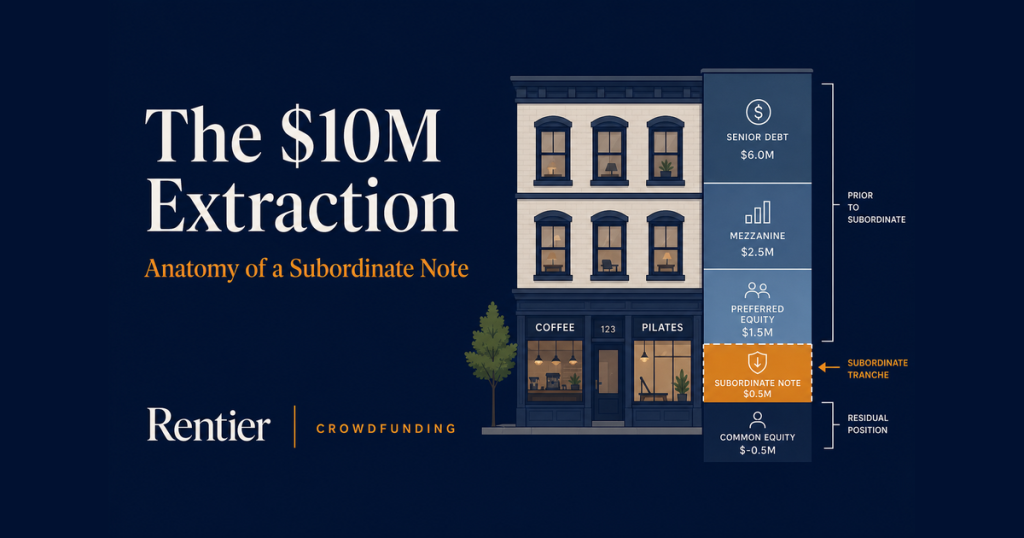
The $10M Extraction: Anatomy of a Subordinate Note
A retail real estate offering promises 11.5% on a loan against a Santa Monica building anchored by Trader Joe’s. The 27-page note supplement describes something narrower: the first-loss slice of that loan, behind a bank, with cure rights that can require investors to pay the bank down. The borrower’s own audited accounts describe something narrower still.
Willow Wealth is the platform formerly known as YieldStreet, where I bought a law-firm loan that lost money. The useful part of that experience wasn’t the loss. It was discovering, years later, that nothing on the one-page tear sheet had been false — and that everything that decided the outcome sat deeper in the file: who the money actually went to, what the borrower was paying for it, and a loan-to-value figure that turned up in a single investor notice a year later at three times the number on the cover.
So when the same platform, renamed, put out a new real estate offering, I read the documents instead of the page. Then I read the borrower’s public filings, which turned out to be the most informative source of the three.
What Is Being Sold
The offering is Santa Monica Mixed-Use Financing: a participation in a $42 million first mortgage on a mixed-use property at 2300 Wilshire Boulevard in Santa Monica, California. The marketing promises an 11.5% net annualized yield, monthly interest, a 19-month target term, a 35% equity cushion and a 65% loan-to-value ratio. The property is described as recently built, three stories, residential over retail, anchored by “a national grocery chain voted #1 in the United States in 2026.”
All of that is accurate. The grocery anchor is Trader Joe’s, which did top the ACSI grocery rankings. The building is real and well located, blocks from the ocean on one of the city’s main commercial corridors.
Who Is Actually Behind It
The offering page names neither the property, the borrower nor the sponsor, and it doesn’t have to. The private placement memorandum reserves the right “in its sole discretion, to not disclose the name or identity of any borrower, guarantor, sponsor, obligor, originator, manager, member, principal or other party related to the applicable Investment.” The supplement describes the sponsor only as a vertically integrated developer headquartered in Hong Kong and listed on the Hong Kong Stock Exchange, operating across China, the US and the UK.
Public records close that gap in about ten minutes:
- Property: 2300 Wilshire Boulevard, Santa Monica — roughly 159,000 square feet gross, three storeys, 30 residential units over about 23,600 square feet of retail, with 190 subterranean parking spaces
- Borrower: GR Properties USA, the American subsidiary of GR Life Style Company Limited (HKEX: 0108)
- Originator and senior lender: Castellan Real Estate Partners, also trading as Castellan Capital, which provided the $42M refinancing in November 2025
- Anchor tenant: Trader Joe’s
Being listed means the guarantor’s finances are public, which is the single biggest advantage an investor has in this deal — and it is an advantage the offering page does nothing to help you use.
The Guarantor Has a Going-Concern Qualification
GR Life Style’s audited results for the year ended 31 December 2025 show revenue of HK$327.9 million (about US$42M), up from HK$310.0 million, and a net loss of HK$109.6 million (about US$14M). That loss is a large improvement on the prior year’s HK$918.5 million, which was driven mostly by fair-value write-downs on Chinese property. But the company remains unprofitable, and finance costs of HK$153.1 million consume nearly half of revenue, leaving interest coverage below 1x and debt-to-equity around 130%.
The offering documents disclose the guarantor’s position as of the end of 2024: $54.5 million of net equity and $5.0 million of cash liquidity. Five million dollars of available cash behind a $42 million loan is thin on its own terms.
The audited accounts say something considerably stronger than “thin.” Ernst & Young’s report on the 2025 financial statements carries a Material Uncertainty Related to Going Concern paragraph:
“[A]s at 31 December 2025, the Group had net current liabilities of HK$838,080,000, which includes an interest-bearing bank borrowing of HK$1,253,251,000 classified as current liability maturity dates of less than 1 year. This condition [. . .] indicate[s] the existence of a material uncertainty which may cast significant doubt about the Group’s ability to continue as a going concern.”
Net current liabilities of HK$838 million is roughly US$108 million. The current borrowings figure, HK$1.25 billion, is about US$161 million falling due inside a year. The auditors did not modify their opinion, and the directors concluded the going-concern basis remains appropriate after reviewing management’s twelve-month cash flow projection. This is a qualification about uncertainty, not a finding of insolvency, and the distinction matters.
What makes it matter to this loan is the specific item the accounts identify as the pivot point:
“The Group’s ability to generate sufficient cash flows to continue as a going concern is subject to significant uncertainty and will depend on whether the loan provided by the aforesaid financial institution for the Culver City project can be successfully renewed. Should the financial institution not agree on the loan renewal resulting in an immediate repayment of the entire loan, the Group may be unable to continue as a going concern.”
That loan is US$26,968,000, it matured on 5 April 2026, and it had not been renewed as at the date of the accounts. Management believes it can be refinanced and was negotiating.
Now hold that against the offering. The note supplement cites the sponsor’s ownership of a 139-unit multifamily property in Culver City, California as part of its credentials — evidence of a real operator with a real California portfolio. The parent’s audited accounts identify the loan on that same Culver City project as the thing on which the entire group’s status as a going concern depends. The credential and the existential risk are the same asset. An investor reading only the offering would see the first and have no way to learn the second.
The wider balance sheet supplies the context. Group other loans outstanding total about HK$1.33 billion, of which roughly HK$902 million — some US$116 million — is denominated in US dollars. This is a company whose dollar liabilities are large relative to everything else about it, refinancing a dollar asset, while its auditors flag a dollar loan it hasn’t renewed.
What You Actually Own
The marketing describes a loan secured by a mixed-use property. The documents describe the junior slice of that loan, held through a chain.
| Tranche | Amount | % of loan | Holder |
|---|---|---|---|
| Senior Note | $29,400,000 | 70.0% | Federally chartered savings bank |
| Subordinate Note — retail investors | $10,000,000 | 23.8% | WW CSTN REL II LLC |
| Subordinate Note — originator | $2,600,000 | 6.2% | Castellan |
Retail money is the first-loss position. In a default the bank is made whole first, and the subordinate holders absorb what’s left. Between the investor and the building sit four layers: you buy a borrower-payment-dependent note from YS ALTNOTES II LLC; that issuer owns the membership interests of WW CSTN REL II LLC; that SPV holds a 79.4% participation in the subordinate note; and the subordinate note sits behind the $29.4M senior note. Payment depends on the borrower paying. Nobody — not Willow Wealth, not Castellan — guarantees it.
Where the $42 Million Goes
The sources-and-uses table is the part of the file I would read first if I only had time for one page.
| Sources | $ | Uses | $ | % |
|---|---|---|---|---|
| Senior Note | $29,400,000 | Existing loan payoff | $30,266,186 | 72.1% |
| Subordinate Note (retail) | $10,000,000 | Property tax payment | $479,196 | 1.1% |
| Subordinate Note (Castellan) | $2,600,000 | Fees and closing costs | $1,265,174 | 3.0% |
| Cash out to sponsor | $9,989,444 | 23.8% | ||
| Total | $42,000,000 | Total | $42,000,000 | 100% |
Just under $10 million — 24% of the loan — leaves as cash to the sponsor. The number is within $11,000 of what the retail tranche is raising. Read the two columns together and the transaction is legible: retail investors put in $10M of first-loss capital, and $10M walks out the door to a parent whose auditors have flagged going concern. That isn’t alignment. Whether it’s a defensible refinancing depends entirely on what the sponsor does with the money, and the documents don’t say.
The Cure Rights
The “35% equity cushion” protects the loan as a whole. What the marketing omits is what the senior lender can require of the junior holders if things go wrong. Per the note supplement, if the underlying loan becomes 90 or more days delinquent or enters any default, the senior note requires a 10% principal paydown within 30 days and full repayment of the outstanding senior balance within 90 days — and those payments are to be made by the holders of the subordinate note, including the retail SPV.
Read that mechanically. A default doesn’t merely expose the junior tranche to eventual losses; it can create an obligation to fund up to $29.4 million on a 90-day clock. A vehicle holding $10 million cannot meet that, which means the practical consequence of a default is a forced sale of the participation, at whatever price is available, rather than a workout. Castellan has separately given a full recourse guaranty on the senior note. That protects the bank. Nobody guarantees the piece retail investors hold.
Leverage Beneath the Leverage
The risk factors note that the SPV “expects to employ leverage to make the Investment and may, in the future, incur additional indebtedness,” and that the leverage provider takes a first priority security interest on the SPV’s assets — ahead of noteholders. The documents state the consequence plainly: the result of such a sale could be “the complete loss of the value of the Investments and, as a result, the value of the Notes.”
The facility also carries cross-default terms tied to other funds managed by Willow Wealth. A problem somewhere else in the platform’s portfolio, unrelated to this building, can trigger a default that lets the leverage provider remove the manager and force a sale. An investor doing diligence on Santa Monica real estate would have no reason to examine that risk, and no way to monitor it.
The Business Plan, and What the Borrower’s Accounts Say About It
Repayment depends on selling the 30 residential units and the retail component. The documents disclose the gating facts: the sponsor has approval to market the units but not to close sales, with final approval expected in the second quarter of 2026 and not guaranteed. The loan matures 1 November 2027 with no extension options. Residential occupancy has fallen from 97% to 83.3% because the sponsor is deliberately not renewing leases ahead of the conversion. The minimum release price of $856 per square foot sits well below the appraised $1,245, which leaves room for price softening.
Two things about that plan are worth an outside investor’s attention.
The first is that the gating item is unverifiable. Permission to close condo sales is not the kind of event that gets reported, so nothing public confirms or denies it — the projected window has now come and gone without a word either way. An investor in the subordinate tranche is asked to underwrite a timeline whose first milestone they cannot check, on a loan with no extension option.
The second is harder to reconcile. GR Life Style’s own annual report, describing this building in its segment disclosure, gives the leasing statistics — an average of about 91% of the commercial area and 89% of the residential area leased during 2025 — and then states the strategy directly: “The plan for the Santa Monica project is to lease out all the commercial units and the residential units.”
That is not the plan the offering describes. The offering tells subordinate lenders that repayment comes from selling the units. The parent’s audited accounts, published weeks later, tell shareholders the plan is to lease them. There are innocent explanations — the accounts describe the year just ended while the offering looks forward, the units are legally condominiums whether rented or sold, and property held for long-term rental sits in a different accounting category than property held for sale, which gives a listed company reasons to describe an asset conservatively. The building’s own website, for what it’s worth, still markets apartments.
I can’t resolve which plan is operative and I’m not going to pretend otherwise. But for a lender whose repayment depends on sales proceeds arriving before a hard maturity, two documents from the same transaction describing two different uses of the same building is the kind of discrepancy you want to have found before you wire money, not after. The history here is already one of changed plans: built as condominiums, operated as rentals when the condo market softened, mortgaged, and now — per the offering — to be sold as condominiums again, with $10 million of equity extracted on the way through.
The Fee Stack
| Fee | Amount | Borne by |
|---|---|---|
| Commitment fee (one-time) | 1.00% | Investor, deducted from invested capital |
| Management fee (annual) | 1.50% | The SPV |
| Servicing fee (annual) | 1.00% | The SPV, paid to Castellan |
| Access fee (annual) | 0.25% | Allocated to investors per the indenture |
| Structuring fee | $100,000 | Originator pays the platform |
On a $10,000 investment the commitment fee means $9,900 actually buys notes. Stack 1.50% management, 1.00% servicing and 0.25% access on top, over a 19-month expected life, and the gross-to-net gap on an 11.5% headline is material — which is the ordinary arithmetic of retail alternatives, and the reason the headline yield is the wrong number to compare across offerings.
The Page Against the File
| What the marketing says | What the documents and filings say |
|---|---|
| “Participation in a loan secured by a mixed-use property” | Participation in the subordinate slice, behind a $29.4M bank note, through four layers of intermediation |
| “35% implied equity cushion” | The cushion protects the whole loan. The junior piece is first-loss, and cure rights can require it to repay the senior balance within 90 days of a default |
| “Repeat originator with vested interest” | Castellan holds $2.6M of the $12.6M subordinate note; retail holds $10M. Castellan’s recourse guaranty covers the senior note |
| “Modern property anchored by major grocery store” | True — and the guarantor is a loss-making Hong Kong listed company whose auditors flagged material uncertainty over going concern, with US$108M of net current liabilities |
| Sponsor track record includes a Culver City multifamily asset | The unrenewed loan on that Culver City project is what the parent’s accounts say its going-concern status depends on |
| “Potential downside protection” | $10M of the $42M is cash out to the sponsor, and the SPV itself borrows, with cross-defaults tied to unrelated Willow Wealth funds |
| “84% performing in line with expectations” | Measured across all matured real estate debt since 2015, at a platform where nine of thirty deals reviewed by CNBC were in default |
Where I Land
This is not a bad building. 2300 Wilshire is well located, Trader Joe’s is a genuine anchor, Santa Monica retail is tight, and the release prices sit below appraised values. If the units get clearance to sell, sell near appraisal, and clear before November 2027, the subordinate note pays 11.5% and returns principal.
The risk isn’t in the real estate. It’s in everything stacked on top of it. You would be buying a borrower-payment-dependent note, issued by an SPV that itself borrows, holding a participation in the junior slice of a mortgage, behind a bank whose cure rights can demand a paydown the SPV cannot fund, on a property owned by a subsidiary of a company whose auditors have flagged going-concern uncertainty — a company that just took $10 million of equity out of the building, the same amount the note is raising, and whose own annual report says the plan for that building is to lease it rather than sell it.
An 11.5% coupon is payment for risk. Whether it’s payment for that stack is a different question, and for me it isn’t close, so I passed. The honest caveat is that this is one investor’s tolerance, not a verdict on the deal: someone who thinks the condo clearance is near-certain and the parent’s refinancing routine could reasonably reach the opposite conclusion from the same file.
What I’d take from it regardless of the answer: on this kind of offering the marketing page and the document file are describing different instruments, and when the borrower is publicly listed there is a third description available for free. It was the one that told me the most, and it’s the one nobody sends you.
Sources
- YS ALTNOTES II LLC — Series Note Supplement, Borrower Payment Dependent Notes Series No. YS CSTN REL II (March 25, 2026); Confidential Amended and Restated Private Placement Memorandum (November 17, 2025); Fourth Amended and Restated Borrower Payment Dependent Notes Indenture (December 29, 2022). Source of the tranche sizes, the sources-and-uses table, the senior-note cure rights, the SPV leverage and cross-default risk factors, the fee schedule, the guarantor’s 2024 equity and liquidity figures, and the condo-approval and occupancy disclosures
- GR Life Style Company Limited (HKEX: 0108), annual results and annual report for the year ended 31 December 2025 — revenue of HK$327.9M and net loss of HK$109.6M against a HK$918.5M loss in 2024; finance costs of HK$153.1M; Ernst & Young’s Material Uncertainty Related to Going Concern paragraph; net current liabilities of HK$838,080,000 and current interest-bearing borrowings of HK$1,253,251,000; the unrenewed US$26,968,000 loan on the Culver City project maturing 5 April 2026 and the directors’ statement that going-concern status depends on its renewal; total other loans of approximately HK$1,330,776,000 including roughly HK$902,456,000 denominated in US dollars; and the Santa Monica segment disclosure giving site area, rentable areas, parking, 2025 leasing averages of about 91% commercial and 89% residential, and the stated plan to lease out all commercial and residential units
- MarketScreener: GR Life Style auditor raises going-concern doubt; TipRanks on the FY2025 results; Simply Wall St: financial health
- Commercial Observer: Castellan Capital loans $42M to refinance a Santa Monica mixed-use complex (November 2025) and The Registry SoCal — borrower and lender identification, roughly 159,000 square feet, 30 units over about 23,600 square feet of retail, Trader Joe’s anchor. Published sources differ on the completion year, so none is asserted here; Urbanize LA tracked the project through construction, and the building’s own site markets the units as apartments
- Commercial Observer on GR Properties’ Culver City development; ACSI 2026 grocery rankings
- The $208M Rebrand: YieldStreet Becomes Willow Wealth — platform-level default history and the CNBC review referenced above
Commentary and personal experience — not investment, legal, or tax advice. Investing carries risk, including total loss of capital. Always do your own due diligence.



Amazing write up on this. Do you mind if I share this?
Thanks, Justin! Glad it was helpful. Feel free to share — all my posts here are free to share anywhere, no permission needed. A link back is appreciated but not required.