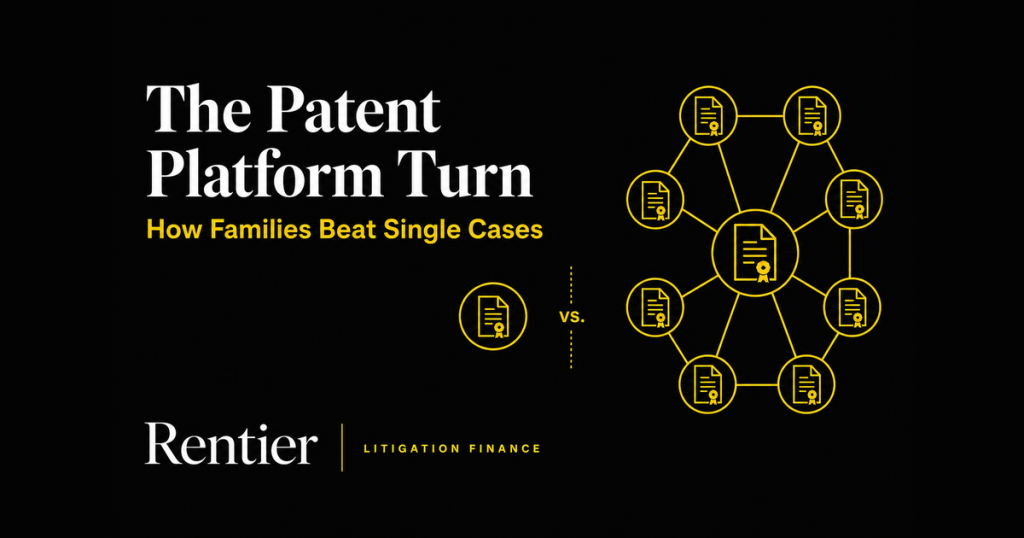
The Patent Platform Turn: How Families Beat Single Cases
Funders moved from single patents to families and licensing campaigns, and the strategy is genuinely better than what I bought as a retail investor. But the thing that actually repriced patent assets over the last eighteen months wasn’t strategy at all. It was a screen at the Patent Office that a challenger cannot appeal — and it is now being written into the rules.
The old model — one patent, one defendant, one big swing — is exactly how I bought patent cases through a retail platform. A couple worked, including a passport-RFID case that returned 1.84x over nine years; most disappointed; the whole book finished barely above breakeven. One of those patent bets still isn’t resolved. I bought in at the end of 2018 and the appeal wasn’t set for oral argument until 2026 — nearly eight years of capital tied up waiting on a single binary outcome, with no ability to influence anything and no way to wait out a holdout.
So when sophisticated funders started moving away from single-case bets, I didn’t read it as industry trivia. I read it as a description of what my own approach got wrong. This post is about whether the new approach is better, and about where its recent returns are actually coming from, which turns out not to be where the pitch decks say.
The Strategy, Compressed
A single patent bet dies from one adverse claim construction, one invalidity finding, one venue ruling, or simply from running out of time. Every element of the platform model exists to stop any one event from being fatal.
Acquire families, not assets. A vehicle buys entire patent families covering different implementations of a core technology, so losing one claim doesn’t end the campaign and a defendant can’t design around a single claim. You aren’t buying a case; you’re building a licensing engine that uses litigation selectively.
License first, litigate selectively. Targets get a business-friendly offer backed by evidence of use and priced below litigation risk, with suits reserved for holdouts. That isn’t courtesy, it’s filtering — willing licensees settle early and cheaply, which compresses duration, and escalating against the rest improves conversion among everyone still negotiating.
Prove infringement industrially. Everything turns on who is using this and whether it can be proven. Teardowns, reverse engineering and claim-chart workflows answer that, and a comprehensive semiconductor teardown runs roughly $50,000 to $150,000. For a single-case investor that’s a large sunk cost against a binary outcome. Spread across twenty targets reading on the same family, the per-target cost collapses while proof quality holds. That cost curve is the real argument for platforms over cases — more than diversification, which is the argument usually made.
Cross-collateralize the capital. Funders and firms increasingly back pools rather than matters, so early settlements from cooperative targets finance prosecution against difficult ones. It also buys the thing I never had: the ability to decline a bad settlement because you aren’t out of money.
For anyone being offered exposure, the structure matters more than the label, because these four carry very different risk:
| Structure | What dominates the outcome |
|---|---|
| Single-case funding | One binary result. What I bought, and what the industry is moving away from. |
| Portfolio funding | Overall pool quality, usually cross-collateralized at law-firm level. |
| Patent acquisition platform | Acquisition discipline and proof-of-use quality. The strategy described here. |
| Blind-pool fund | Manager skill and track record, full stop. |
One caution about the family logic, since it’s the part most likely to be oversold. A count is not a portfolio. Twenty patents in a family that all depend on the same claim-construction ruling or the same piece of prior art are one bet wearing a plural. The question to ask a sponsor is not how many patents are in the family but what single event would take out the most value at once, and whether that correlation has been priced.
What Actually Changed
The cheapest way to kill a patent campaign was never to win at trial. It was to challenge validity at the Patent Trial and Appeal Board, where inter partes review let a defendant attack the patents faster and far cheaper than district court. For a platform holding a family, IPR was the one threat that scaled the way the strategy did, because the same prior art can be aimed at the whole family. That threat has substantially receded, and not because of anything funders did.
The headline numbers are dramatic. The IPR institution grant rate stood near 82% in January 2025, bottomed at 19.4% in August 2025, was still 21.5% in January 2026, and had recovered only to 47.4% by June 2026 on a much smaller base. Demand collapsed with it: monthly IPR filings fell from 131 in January 2025 to 22 in June 2026, and first-quarter petitions hit a historic low of 131, down 64% year over year.
But the mechanism matters more than the headline, and it took reading the Patent Office’s own statistics to get it right. What happened is not that the Board started rejecting challenges on their merits. Institution was split into two stages, and a policy screen was installed in front of the merits stage. Through the third quarter of fiscal 2026:
| Stage | Denied | Passed on |
|---|---|---|
| Director’s discretionary considerations | 407 (60%) | 274 referred (40%) |
| Merits review | 102 (25%) | 314 granted (75%) |
The two rows don’t chain arithmetically: the merits pool is larger than the 274 referred, because petitions where the patent owner never raised discretionary considerations go straight to a panel without passing through the Director’s screen.
So a petition that reaches the merits is still instituted about three times out of four — one analysis of Director Squires’s orders puts discretionary denials at 64% of petitions considered while merits institution ran near 75%, and just under 70% in 2026 alone. The Patent Office’s own year-to-date institution rate by petition is 66%. “IPRs are dead” is the wrong summary. The accurate one is narrower and, for an investor, more useful: a challenger’s problem is no longer whether its prior art is any good. It’s whether the petition survives a discretionary gate that has nothing to do with prior art and cannot be appealed.
Two features of that gate matter for a platform’s economics. It is asymmetric in exactly the direction that helps: measured over a trailing twelve months at mid-2026, institution ran 27.2% against patents held by non-practicing entities versus 41.4% against operating companies — and NPE-held patents are precisely what a platform holds. And its effect compounds, because when the cheap early exit closes, validity fights move into district court, where they cost far more and resolve years later. That is a large, genuine improvement in platform economics, and none of it appears in a deck about families, teardowns or cross-collateralization.
How it happened is a sequence of administrative decisions, not legislation. In February 2025 the Patent Office rescinded the 2022 memorandum that had constrained discretionary denials, restoring older Fintiv practice. A March 2025 memorandum from then-Acting Director Coke Morgan Stewart formalized a separate discretionary-briefing track, split institution so that discretionary questions went to the Director and merits questions came later, and justified it as workload management to preserve capacity for ex parte appeals — while opening the door to arguments about “settled expectations” and compelling economic and national-security interests. Director John Squires, sworn in that September, centralized institution decisions in his own office in October 2025 and began issuing them as summary notices. A March 2026 memorandum added a party’s investment in US manufacturing as a factor. When petitioners pivoted toward ex parte reexamination, the office moved to curtail that route too. And in November 2025 the Federal Circuit’s decision in In re Motorola Solutions indicated this discretionary authority is largely insulated from judicial review.
The Tailwind Is Becoming Permanent, Which Cuts Both Ways
Everything above describes discretion, and discretion is reversible by whoever holds the office next. That was the risk worth flagging. It is now being reduced, and an investor should understand how.
A rulemaking published in October 2025 proposed to convert the practice into categorical bars, and on July 22, 2026 the final rule went to the Office of Management and Budget for review. The text isn’t public yet, but the proposal would bar institution where the challenged claims have already been upheld against invalidity in any other forum — district court, the ITC, a prior Board proceeding, even ex parte reexamination — and bar it where parallel litigation is likely to resolve validity first, converting what had been one discretionary Fintiv factor into a dispositive rule. It would also condition institution on the petitioner forgoing the same invalidity grounds elsewhere, with only a narrow “extraordinary circumstances” escape.
If that lands as proposed, the screen stops being a memo and becomes a regulation. Regulations are considerably harder to unwind than a director’s practice, so the durability of the tailwind improves. It does not become permanent: a final rule can be challenged, and a future administration can re-propose. The honest framing for an underwriting model is that this is regulatory risk in the ordinary sense rather than personnel risk — better, but still not the same thing as a strategy producing the return.
The reason I keep pressing on this is that procedural facts, not merits facts, increasingly decide patent outcomes, and the evidence runs in both directions. Delaware is the counterexample. When Chief Judge Colm Connolly began requiring disclosure of litigation funders in April 2022, patent filings in that district fell 41% over the following two years against a 15% national decline, and the cases migrated to Texas, where funding arrangements stay confidential. A model that quietly depends on not disclosing the funder carries a risk no teardown touches.
And one finding from that same courtroom deserves more attention than it got, because it undercuts a number both sides of the reform debate rely on. A study published in mid-2026 examining funding in Connolly’s court — the one place where disclosure is actually compelled — found that patent cases account for nearly all funded matters there, and that roughly 15% of patent suits carry outside financing. The reform debate has largely run on an industry estimate of around 30%. The only courtroom generating real disclosure data produced a number about half that. That should make everyone slightly less confident, including me.
The Returns, and the Variable That Decides Them
Now the part that matters more than any of the strategy. Gross multiples in this business are respectable and net returns to an investor are often not, and the gap has two separate causes that get conflated.
| Item | Amount | Notes |
|---|---|---|
| Capital committed | $100 | What the investor signs up for |
| Capital deployed | $85 | 15% never gets invested |
| Gross proceeds | $153 | 1.80x on deployed, wins and losses combined |
| Management fees and expenses | −$8 | Charged on commitments, compounding over the hold |
| Performance fees | −$7 | Depends on the waterfall |
| Net to investor | $138 | 1.62x on deployed, 1.38x on committed |
The trap in that table is the denominator. Comparing 1.80x on deployed capital to 1.38x on committed capital produces a 0.42x gap that gets described as fee drag, and it isn’t. Fees account for 0.18x of it. The other 0.24x is simply capital that never got invested — more than half the apparent erosion, with nothing to do with the fee schedule. (Undrawn commitments usually sit in T-bills earning something, so the real drag is slightly smaller than the model implies.) Insist on one denominator throughout, because this confusion always flatters whichever number the sponsor prefers.
Then apply the duration patent cases actually take:
| Net result | Over 3.5 years | Over 6.5 years |
|---|---|---|
| 1.62x on deployed | 14.8% IRR | 7.7% IRR |
| 1.38x on committed | 9.6% IRR | 5.1% IRR |
A 1.80x gross portfolio, which is a decent result, becomes a mid-single-digit return to the investor if the campaigns run six or seven years. That is why the licensing-first pillar matters more than the ones about patents: compressing duration is worth more than raising the multiple. Cutting the hold from 6.5 years to 3.5 nearly doubles the IRR on identical cash returned. Ask a sponsor for weighted average duration before asking about target multiple, and treat an answer that skips duration as an answer about the multiple only.
The published evidence sits in the same range, with a caveat I’d want applied to my own use of it. Burford’s IP vertical shows roughly 1.83x across 46 concluded and partially concluded assets, and among the fully concluded winners only one exceeded 5x and none exceeded 10x. That is workmanlike specialty finance, not the asymmetric bet a “record damages” headline implies. But the number is softer than it looks in both directions: about 70% of that IP book isn’t fully concluded, and because losers close in a single event while multi-defendant winners pay in stages, the closed portion is weighted toward failures — the partially realized investments are running near 2.86x on their concluded portions. The 1.83x is also dragged by one large pharmaceutical investment that returned 1.25x on nearly $100M; excluding it, the other twelve fully concluded winners produced about 2.76x. “IP” is not “patent,” and one big low-multiple deal is doing a lot of work in the headline.
What survives all that hedging is the shape rather than a return figure: bounded upside, long duration, and no outlier available to cover an underwriting mistake. That shape is exactly what the platform turn is a response to. If your ceiling is capped and your median win is well under $100M, you build a business from many correlated mid-sized recoveries rather than one enormous swing you will never collect. The strategy is rational precisely because the returns are moderate.
The Part Nobody in This Debate Says Out Loud
An honest look at the vocabulary: the “patent acquisition platform” I’ve been admiring is a non-practicing entity with better process. It buys patents it did not invent, from inventors who couldn’t or wouldn’t enforce them, and monetizes them through licensing campaigns backed by the threat of suit in plaintiff-friendly venues. That is precisely the activity patent-reform advocates describe as a tax on innovation.
I don’t think the critique is right as stated. The claim that funders bankroll baseless cases hoping for a lottery ticket doesn’t survive contact with the fund arithmetic or the disclosed return data, which I worked through against the primary sources separately. Professionalization also cuts toward merit: an operator spending $150,000 on a teardown before sending a demand letter is filtering harder than one who isn’t. But “platform” is a flattering word for a contested activity, and my comfort with it rests on an argument I made rather than a fact I verified. Someone whose product gets targeted by one of these campaigns would describe the identical workflow in considerably less admiring language.
There’s a related discomfort I should name rather than bury. The single largest improvement in this asset class’s recent economics is a government screen that makes it harder to test whether the patents being asserted are valid. I can hold the view that the resulting business is a reasonable investment and still notice that “harder to invalidate” is not the same as “more meritorious,” and that an investor benefiting from the first should not claim credit for the second.
Where I Land
The platform turn is a real improvement on the single-case bets that underwhelmed me. Families beat single patents, licensing-first beats litigating everything, and cross-collateralized capital beats being a retail investor with no ability to wait out a holdout. If I take patent exposure again it changes how rather than whether: through a disciplined fund sponsor, never a single case picked off a platform, which is the very thing the industry is abandoning.
- Underwrite duration, not multiple. A 1.80x gross book returns mid-single digits net over a patent-length hold. Duration is the variable that decides the outcome, and it’s the one sponsors are least eager to quote.
- Ask how much of the thesis rests on the institution screen. If a manager’s underwriting assumes a 27% institution rate against NPE-held patents, it is carrying a bet on agency policy. That’s a legitimate bet, and the pending rule makes it a more durable one, but it should be priced as regulatory exposure rather than sold as strategy.
- Every damages statistic used to size this market is pre-appeal. Award tallies count verdicts that haven’t yet met the Federal Circuit, where the large ones systematically don’t survive. Discount accordingly.
The tell for whether a sponsor is running the strategy or just wearing it won’t be in the section about patent families. It’ll be whether they can tell you how long the money is gone, and what happens to their model if the Patent Office changes its mind.
Sources
- USPTO, PTAB Trial Statistics, June 2026 — FY2026 through Q3 (Oct. 1, 2025–June 30, 2026): Director’s discretionary considerations, 407 denied (60%) against 274 referred (40%); merits or other considerations, 314 granted (75%) against 102 denied (25%); fiscal-year-to-date institution rate by petition of 66%
- Quinn Emanuel: Trends in IPR Institution Rates Under Director Squires — discretionary denial of 64% of petitions considered, merits institution near 75% and just under 70% in 2026; the four-group order format
- Unified Patents: Patent Dispute Report, First Half 2026 — institution grant rate near 82% in Jan. 2025, 19.4% in Aug. 2025, 21.5% in Jan. 2026, 47.4% in June 2026 on a smaller base; trailing-twelve-month rates of 27.2% against NPEs and 41.4% against operating companies; monthly IPR filings from 131 to 22; Q1 2026 report — petitions down 64% to a historic low of 131; In re Motorola Solutions (Nov. 2025) insulating discretionary authority from review
- Fish & Richardson: USPTO IPR institution rules advance to final review — final rule (RIN 0651-AD89) submitted to OIRA July 22, 2026, text not public; the Oct. 17, 2025 proposal (90 Fed. Reg. 48335) and its categorical bars on prior validity determinations, parallel litigation likely to resolve validity first, the enhanced stipulation condition, and the narrow extraordinary-circumstances exception
- Morgan Lewis: From Stewart to Squires — the PTAB’s first-year reset — Feb. 28, 2025 rescission of the 2022 memorandum; Mar. 24, 2025 guidance restoring pre-2022 Fintiv/Sotera practice; the Mar. 26, 2025 bifurcation of discretionary and merits review on workload grounds; “settled expectations” and economic and national-security considerations; Squires sworn in Sept. 23, 2025 and centralizing institution in Oct. 2025 with summary notices
- RPX: Q1 in Review — USPTO further narrows IPR — the March 2026 domestic-manufacturing factor and the curtailment of ex parte reexamination as an alternative route
- Bloomberg Law: Disclosure order targeting funders stunts Delaware patent suits — University of Utah study (Prof. Jonas Anderson): Delaware filings down 41% in the two years after Chief Judge Connolly’s April 2022 standing order against a 15% national decline, with migration to non-disclosure districts; MLex (July 1, 2026) — roughly 15% of patent suits before Connolly carry outside funding, against the ~30% industry estimate the reform debate relies on
- Burford Capital: Principal Finance portfolio data as of 31 Dec. 2025 — IP vertical at roughly 1.83x across 46 concluded and partially concluded assets, about 70% of the IP book not yet fully concluded, partially concluded assets near 2.86x on concluded portions, a 2024 pharmaceutical investment at 1.25x on $99.9M, twelve remaining fully concluded winners at about 2.76x, one asset above 5x and none above 10x
- Lex Machina: 2025 Patent Litigation Report — the 2024 filing rebound attributable largely to design-patent and ANDA litigation and non-high-volume plaintiffs; EDTX over 1,000 new suits with Judge Gilstrap presiding over nearly 800; the damages column counting only awards not reversed on appeal; Unified Patents: 2025 in review — NPE filing share of 55.4% in 2025 against 51.8% in 2024, roughly 91% of high-tech suits, and Texas concentration
- Bowman Heiden, The Survival of U.S. Patent Damages on Appeal (2025) — upheld awards averaging $103M against $267M for non-upheld, with a median nearer $35–40M
- TechInsights: teardown services and evidence of use; Legal Funding Journal: gross versus net return dispersion in commercial litigation finance; Burford Capital: how law firms use portfolio finance
Commentary and personal experience — not investment, legal, or tax advice. Investing carries risk, including total loss of capital. Always do your own due diligence.