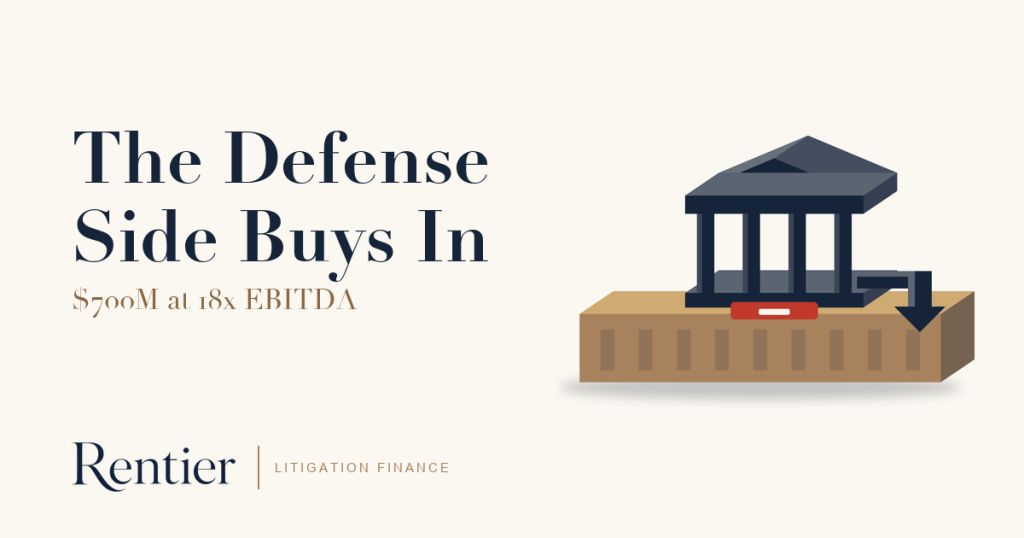
The Defense Side Buys In: A $700M Bet on More Litigation
Charlesbank is close to paying roughly $700 million for a management services stake in a 500-lawyer insurance defense firm — the largest private equity investment in an American law firm yet attempted. The pitch the firm made to buyers is that private equity and litigation finance are generating more liability claims than it can currently handle. I am one of the people funding the other side of those claims, and somebody has just put a price on how long my side keeps growing.
My money sits where the claims come from. Litigation finance is the largest single line in my alternative portfolio, and every dollar of it is on the plaintiff side of disputes that somebody has to defend. Wood Smith Henning & Berman is one of the firms that defends them. It has now told prospective buyers that the money behind claimants is expanding its market faster than it can serve, and a private equity firm appears to believe that enough to underwrite it at a mid-teens multiple. That is an outside opinion on my asset class, priced in cash, from a party with no reason to flatter it.
What Is Actually Being Bought
The reported terms, as first carried by the Financial Times and picked up across the legal press:
| Reported terms | Figure |
|---|---|
| Reported valuation | ~$700 million |
| WSHB revenue, last year | $244 million |
| Adjusted EBITDA | $38.2 million |
| Implied multiple on adjusted EBITDA | ~18x |
| Estimated 2026 earnings (alternative basis) | $46 million |
| Implied multiple on 2026 estimate | ~15x |
| Lawyers, across 43 offices in 35 states and London | 500+ |
| Charlesbank assets under management | ~$22 billion |
Two different earnings bases are circulating and they are not reconcilable from public reporting. Above the Law puts the price at about 18 times adjusted EBITDA of $38.2 million; the Financial Times line is that the price rests on a multiple of an estimated $46 million of 2026 earnings, which is about 15 times. One is trailing and adjusted, the other is forward and estimated, and the gap between them is roughly the entire growth story being sold. I cannot tell from outside which figure the parties are actually transacting against.
What the $38.2 million does tell me is the margin: 15.7% on $244 million of revenue. That is an hourly-billing business with a real cost base, not a partnership harvesting contingency upside.
The sale was run by Riverbrook Capital, with Piper Sandler advising Charlesbank. A letter of intent has been signed and a definitive agreement is expected within weeks. Neither party has confirmed anything; both declined to comment.
The Structure Is the Deal
Charlesbank is not buying a law firm, because in most US states it cannot. It is buying into a management services organization — a separate entity that holds the firm’s billing, technology, real estate and back-office operations and supplies them to the attorney-owned practice for a fee. The lawyers keep the law. The investor keeps the machine, and the machine sends an invoice.
Follow that through and the valuation resolves into a single number that nobody has published. The MSO’s only revenue is the fee it charges the practice. Its equity is therefore worth the capitalized value of that fee and nothing else. For a stake in the services entity to be worth anything close to $700 million against a firm generating $38.2 million of adjusted EBITDA, the fee has to be set high enough to absorb substantially all of the practice’s economic profit. There is no other way for the arithmetic to work.
Which is the whole regulatory question, stated as arithmetic rather than as ethics. The rule against non-lawyer ownership exists to stop outside capital from taking the profits of legal practice and, through that, influencing it. The MSO complies with the form of the rule precisely — no non-lawyer owns any part of the practice — while the fee does the thing the rule was written to prevent. If a state bar or a court ever decides that a services fee calibrated to firm profitability is fee-sharing wearing a different hat, the structure is in trouble. That determination has not been made, and I have no basis for predicting it.
The Thesis Is My Side of the Market
Here is the part that made me want to write this down rather than let it pass as a deal note.
WSHB’s argument to prospective buyers, as reported, is that rising funding from private equity and litigation finance groups is driving more liability claims and increasing demand for defense work beyond what the firm can handle without fresh capital. That is the growth story. Not a new practice area, not a geography, not a technology — the expansion of the money behind claimants.
So a private equity firm is about to pay somewhere between fifteen and eighteen times earnings for a claim on the revenue that my asset class produces. It is buying the exhaust rather than the engine. And its return does not depend on any of those claims succeeding.
That asymmetry is the thing worth sitting with. Insurance defense is billed by the hour. The MSO’s cash flow tracks the volume of disputes that get defended, and it is indifferent to who wins them. A wave of funded claims that all fail is, for this business, an excellent few years. My funds are paid only out of recoveries: the same wave, if it fails, returns me nothing. We are exposed to the identical growth driver on opposite terms, and the party that just attracted institutional capital at a mid-teens multiple is the one collecting a toll regardless of outcome.
I do not think that makes my position worse. It does make it the more levered of the two, in a way I would rather see stated plainly than discover in a distribution notice.
What I Can Legitimately Take From It
Very little about my returns, and something real about volume.
A buyer of this size, advised, with a signed letter of intent, is a genuine data point that a sophisticated party expects litigation volume to keep rising for long enough to service a mid-teens multiple. That is not nothing. It is a better signal than a trade association forecast, because it is money and it is committed for years.
But volume is not return, and I have my own evidence for that. Across 42 LexShares case investments over seven years I earned 1.25% IRR. There was no shortage of litigation in that period and no shortage of access to it. What was short was recovery, net of duration and loss rate. A market that produces more disputes produces more billable defense hours with near-certainty, and more claimant recoveries only if the underlying claims are good and get resolved before the clock eats the return. Charlesbank is underwriting the first proposition. I need the second, and this deal says nothing about it.
The Honest Handicap
Nothing has been signed. This is a letter of intent reported by journalists, with both parties declining to comment. Deals of this profile collapse, and one this structurally novel has more ways to collapse than most. If it does, the interesting part — a defense firm raising capital on the strength of claimant funding — survives the failure, but the price does not.
I cannot reconcile the two earnings figures and have not tried to split the difference. Roughly 18x on trailing adjusted EBITDA and roughly 15x on estimated forward earnings are different statements about the same transaction, and I do not know which one the parties are using. Anyone quoting a single multiple with confidence, including me, is choosing a source.
It is also unclear what the $700 million attaches to. The reporting describes it variously as valuing the firm, valuing the business, and as the basis for a stake in the services entity. Whether that is enterprise value for the MSO, for the practice and MSO combined, or the implied value underlying a minority position materially changes what is being said, and I could not establish it from public sources.
WSHB’s thesis is a seller’s thesis. A firm seeking outside capital has every incentive to describe its demand as inexhaustible and its constraint as purely financial. That the argument happens to flatter my asset class is a reason to discount it, not to enjoy it. I am treating it as a claim made in a negotiation, which is what it is.
The regulatory ceiling is unknown and I am not the person to handicap it. Several states are moving to restrict MSO arrangements. Whether this structure survives contact with a determined bar regulator is a question of professional-responsibility law, not finance, and I have no expertise in it.
And I hold nothing here. I have no exposure to Charlesbank, to WSHB, or to any MSO. My interest is entirely in what the deal implies about the market my capital sits in, which means I am reading a transaction I cannot participate in and would not be offered.
Where I Land
I have spent a lot of time asking whether litigation finance produces returns. This deal asks a different and less flattering question: whether litigation finance produces revenue for other people, reliably enough to be capitalized.
Charlesbank’s answer appears to be yes. The structure it is using takes the safest possible position on that answer — hourly, outcome-indifferent, secured to a services fee, insulated from every case actually being right. My position takes the least safe one. We are both betting that more claims get funded and brought. Only one of us needs them to win.
That does not change what I hold, because I cannot change what I hold. It does sharpen the question I put to a general partner, which is no longer whether the pipeline is growing. Everyone now agrees the pipeline is growing; a private equity firm is paying fifteen times earnings for it. The question is what share of it recovers, and nothing in this transaction requires anyone to know.
Sources
- Above the Law, “Private Equity Found A Law Firm That Said Yes” — letter of intent signed; valuation around $700 million; revenue of $244 million last year; “about 18 times the firm’s adjusted EBITDA of $38.2 million”; more than 500 lawyers across 43 offices in 35 states and London; Charlesbank Capital Partners, a Boston firm with some $22 billion under management that began by managing Harvard’s endowment; would be the largest private equity investment in an American law firm to date; the MSO described as “the structure that lets an investor own the billing, the software, and the back office while the lawyers keep control of the law part of the firm”; insurance defense characterized as predictable, high-volume, sticky repeat-business work
- Traders Union, “Charlesbank nears WSHB stake purchase in U.S. legal sector push”, reporting the Financial Times — the price based on a multiple of WSHB’s estimated $46 million of 2026 earnings; Riverbrook Capital engaged by WSHB to seek a buyer and Piper Sandler advising Charlesbank; both parties declining to comment; the deal extending non-lawyer-backed ownership structures beyond personal injury into insurance defense; and WSHB’s argument that “rising funding from private equity and litigation finance groups is driving more liability claims and increasing demand for defence work beyond what it can handle without fresh capital”
- LawFuel, “Private Equity Eyes $700m WSHB Deal in Major Test for Big Law’s Ownership Rules” (Aug 20, 2026) — neither party has publicly announced a deal and the terms remain subject to negotiation; the structural division between a regulated professional practice and a capital-backed operating platform; jurisdiction-dependent restrictions on fee-sharing with non-lawyers, non-lawyer ownership, and arrangements allowing non-lawyers to direct professional judgment
- Legal Funding Journal — “Charlesbank Nears $700M MSO Deal for Wood Smith Henning & Berman in Largest US Law Firm Play Yet” (Aug 27, 2026); the MSO holding back office, billing and technology operations and supplying them to the attorney-owned practice for a fee, allowing outside capital to participate in law firm economics without triggering the prohibition on non-lawyer ownership; the deal following a wave of MSO formation involving private equity and litigation funders in personal injury, as several states move to restrict such arrangements
- Author’s own records, reconciled against the Portfolio page — litigation finance is the largest single line in the alternative book, held across three active private funds, all plaintiff-side
Commentary and personal experience — not investment, legal, or tax advice. Investing carries risk, including total loss of capital. Always do your own due diligence.